
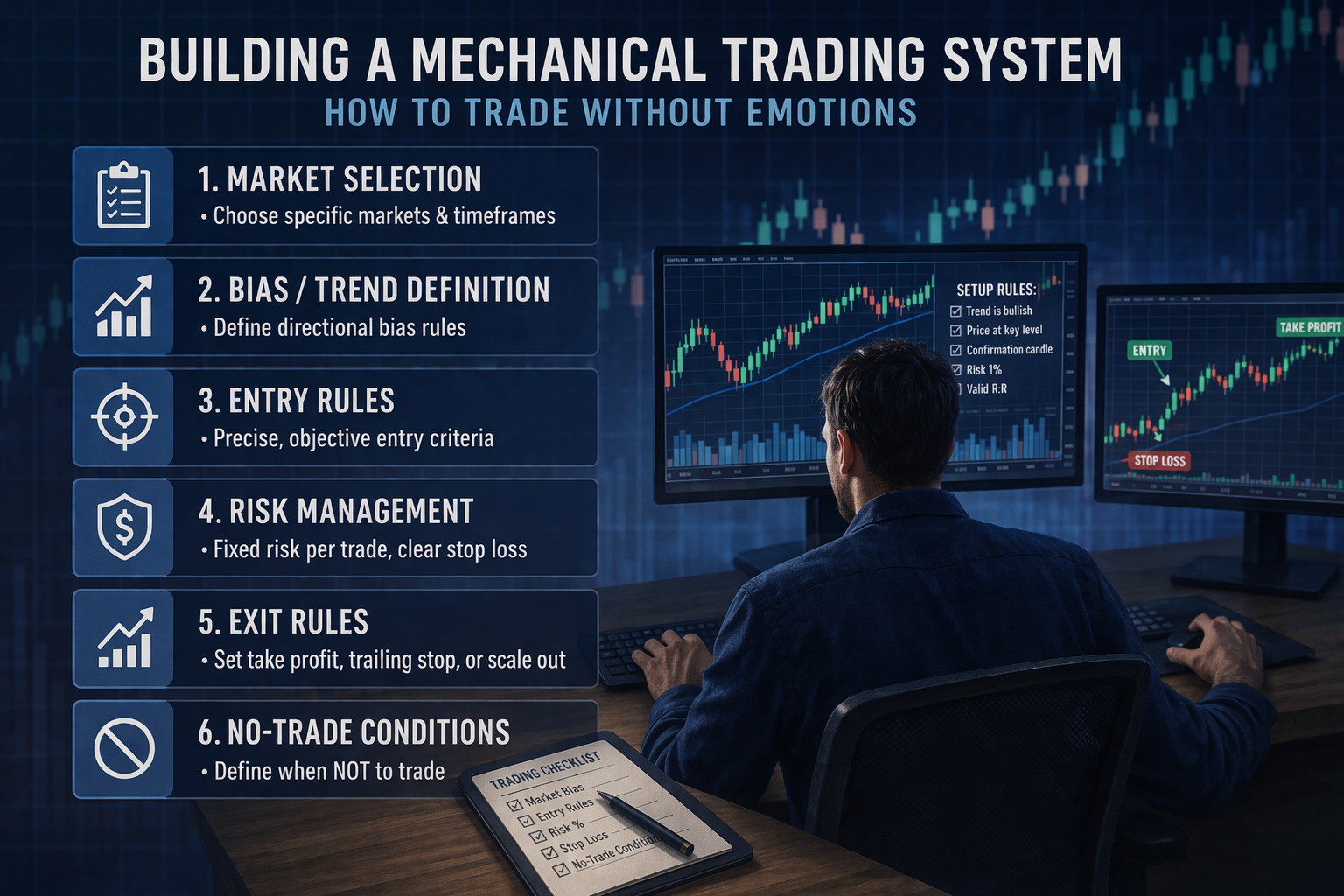
Building a Mechanical Trading System: How to Trade Without Emotions
At some point in every trader’s journey, one realization becomes unavoidable:
Emotion is the problem.
It does not matter how good your analysis is. It does not matter how strong your strategy appears. The moment emotions begin to influence your decisions, consistency begins to break down.
You hesitate when you should act. You act when you should wait. You increase risk when you feel confident and reduce it when you feel uncertain. You override your own rules without realizing it.
Over time, this creates unstable results.
This is why many traders eventually move toward one idea:
Remove emotion from trading.
But how do you actually do that?
This is where mechanical trading systems come in.
A mechanical trading system is designed to eliminate decision variability. It replaces subjective judgment with objective rules. It transforms trading from an emotional activity into a structured process.
This concept is closely tied to what we explored in trading consistency, where the real problem is not knowledge, but execution.
In this article, we will break down what a mechanical trading system is, why it works, and how to build one that supports consistent performance.
—
What Is a Mechanical Trading System?
A mechanical trading system is a rule-based approach to trading where every decision is predefined.
It answers every critical question before the trade happens:
- When do you enter?
- Where do you place your stop loss?
- Where do you take profit?
- How much do you risk?
- When do you stay out of the market?
There is no guessing.
There is no “feeling.”
There is no interpretation in real time.
Everything is defined in advance.
This is what separates mechanical trading from discretionary trading.
In discretionary trading, decisions are influenced by judgment. In mechanical trading, decisions are governed by rules.
—
Why Most Traders Fail Without a System
Without a structured system, trading becomes reactive.
Each decision is influenced by the current situation, recent outcomes, and emotional state.
This creates variability.
For example:
- You take a trade early because it “looks good”
- You skip a valid trade because of a previous loss
- You increase position size after a win
- You move stop loss because you feel uncertain
Each of these actions may feel justified in the moment.
But collectively, they destroy consistency.
This is the same behavioral pattern we identified in common trading mistakes.
Without structure, your performance is controlled by emotion.
—
The Core Purpose of a Mechanical System
The goal of a mechanical system is not to guarantee profits.
The goal is to guarantee consistency in execution.
This is a critical distinction.
Because consistency in execution is what allows a trading edge to play out over time.
Without it, even a profitable strategy fails.
With it, even a simple strategy can produce stable results.
—
The Key Components of a Mechanical Trading System
Every mechanical system must include the following components:
—
1. Market Selection Rules
You must define what markets you trade.
For example:
- Forex majors only
- Specific crypto pairs
- Indices or commodities
This reduces noise and improves focus.
—
2. Timeframe Definition
Consistency requires fixed timeframes.
Switching between timeframes creates confusion.
For example:
- Analysis on 4H
- Entry on 1H
This structure must remain constant.
—
3. Entry Criteria
This is the most critical part of your system.
Your entry must be clearly defined.
For example:
- Trend direction must be bullish
- Price must retrace to a key level
- Confirmation candle must form
If any condition is missing, the trade is not taken.
—
4. Risk Management Rules
Risk must be predefined.
This includes:
- Position size
- Stop loss placement
- Maximum risk per trade
This is where many traders fail, as explained in risk management strategies.
—
5. Exit Strategy
Your system must define how trades are closed.
This can include:
- Fixed take profit levels
- Trailing stop rules
- Partial profit-taking
Without exit rules, decisions become emotional.
—
6. No-Trade Conditions
A complete system defines when NOT to trade.
For example:
- Low volatility periods
- High-impact news events
- Unclear market structure
This prevents unnecessary trades.
—
Why Mechanical Systems Improve Consistency
Mechanical systems remove decision variability.
They reduce the influence of:
- Fear
- Greed
- Frustration
- Overconfidence
This is critical because, as explained in trading psychology, emotions are the primary driver of inconsistent behavior.
By replacing emotion with rules, mechanical systems create stability.
—
The Reality: Mechanical Trading Is Not Easy
Many traders assume that rule-based trading is easier.
It is not.
It is psychologically demanding.
Because it requires you to:
- Follow rules even when you feel uncertain
- Take losses without emotional reaction
- Avoid trades that “look good” but do not meet criteria
- Trust the system over your instincts
This is where most traders fail.
Not because the system is flawed.
But because they cannot follow it consistently.
This brings us back to the core issue:
Execution.
How to Build Your Own Mechanical Trading System (Step-by-Step)
Understanding the concept of a mechanical trading system is not enough.
You must be able to build one that fits your personality, your time availability, and your market of choice.
This process is not about copying someone else’s strategy.
It is about creating a structured framework that you can execute consistently.
Below is a step-by-step approach to building your own mechanical trading system.
—
Step 1: Define Your Trading Environment
Before you build a system, you must define where you operate.
This includes:
- Markets (Forex, Crypto, Indices, Commodities)
- Pairs or instruments you will focus on
- Trading sessions (London, New York, etc.)
- Time commitment (full-time or part-time)
Example:
A trader who can only trade in the evening should not build a system that requires constant intraday monitoring.
Misalignment between lifestyle and system design leads to inconsistency.
—
Step 2: Define Your Market Bias Framework
Your system must define how you determine direction.
This is your bias.
Without a clear bias framework, entries become random.
Example bias rules:
- Trend direction based on higher timeframe structure
- Moving average alignment
- Market structure (higher highs and higher lows)
This ensures that you are not trading against your own system.
—
Step 3: Build Precise Entry Rules
Your entry must be objective.
If two traders follow your system, they should enter the same trade.
Example entry model:
- Price returns to a key support/resistance level
- Confirmation candle forms (engulfing, rejection, etc.)
- Market aligns with higher timeframe bias
Each condition must be clearly defined.
If a condition is vague, it introduces subjectivity.
And subjectivity leads to inconsistency.
—
Step 4: Define Risk Management Rules
This is non-negotiable.
Your system must answer:
- How much do you risk per trade?
- Where is your stop loss placed?
- What is your maximum daily risk?
Example:
- Risk 1% per trade
- Stop loss below structure
- Maximum 3 trades per day
This aligns with principles discussed in risk management strategies, where stability is built through controlled exposure.
—
Step 5: Define Exit Rules
Exits must be planned before entry.
This prevents emotional decisions during the trade.
Common exit methods:
- Fixed risk-reward ratio (e.g., 1:2 or 1:3)
- Trailing stop
- Partial profit-taking
Example:
Take 50% profit at 1:1, move stop to breakeven, let the rest run to 1:3.
This structure removes uncertainty.
—
Step 6: Define No-Trade Conditions
A complete system includes rules for when NOT to trade.
This is often overlooked.
Example no-trade conditions:
- Before major news events
- During low volatility sessions
- When market structure is unclear
This prevents unnecessary losses.
—
Backtesting Your Mechanical System
Once your system is defined, it must be tested.
Backtesting allows you to evaluate performance over historical data.
This helps you understand:
- Win rate
- Risk-reward profile
- Drawdowns
- Expected profitability
Without testing, you are trading blindly.
Backtesting builds confidence.
And confidence supports consistency.
—
Forward Testing and Real Market Application
After backtesting, the system must be applied in real market conditions.
This is where most traders struggle.
Because real trading introduces:
- Emotional pressure
- Execution delays
- Market unpredictability
This is why many traders fail to follow systems they already know.
The issue is not the system.
It is execution under pressure.
—
The Execution Problem (Where Most Traders Fail)
Even with a perfect system, traders still fail.
Why?
Because they override their own rules.
For example:
- Skipping valid trades after a loss
- Taking invalid trades out of boredom
- Increasing risk after wins
- Moving stop loss to avoid losses
This behavior destroys consistency.
It is the same issue we identified in trading inconsistency.
—
How to Actually Follow Your System
Building a system is one thing.
Following it is another.
To improve execution, you must introduce control mechanisms.
—
1. Use a Pre-Trade Checklist
Every trade must pass through a checklist.
If any condition is missing, the trade is not taken.
—
2. Reduce Position Size
Lower risk reduces emotional pressure.
This makes it easier to follow your rules.
This aligns with the concept of trading small lots to improve discipline.
—
3. Limit Daily Trades
More trades = more chances to break rules.
Limiting trades improves focus.
—
4. Track Behavior
After each trade, record:
- Did I follow my system?
- Did I respect my risk?
- Was this trade emotional?
This creates accountability.
—
The Difference Between Mechanical and Automated Trading
Mechanical trading does not mean fully automated trading.
A mechanical system can still be executed manually.
The difference is:
- Mechanical: Rule-based decisions
- Automated: Computer executes trades
You do not need automation to achieve consistency.
You need structure.
—
The Long-Term Advantage of Mechanical Trading
Over time, mechanical systems provide:
- Stable execution
- Reduced emotional influence
- Clear performance evaluation
- Improved confidence
This creates long-term growth.
—
The Final Truth
Most traders are not inconsistent because they lack knowledge.
They are inconsistent because they lack structure.
A mechanical trading system solves this problem.
It removes decision variability.
It reduces emotional influence.
It creates consistency.
—
Conclusion
Trading without structure leads to inconsistency.
Trading with structure leads to control.
A mechanical trading system is not just a strategy.
It is a framework for disciplined execution.
Because in trading, success is not about making the right decision once.
It is about making the right decision repeatedly.
And repetition requires structure.
That structure is your system.
