
Crises—whether war, inflation, financial collapse, or geopolitical upheaval—test assets. Productive assets (businesses, stocks) can suffer prolonged damage; claims on institutions can default. Gold has repeatedly demonstrated a different pattern: preservation of purchasing power when other systems falter.
This is not because gold “always rises” (no such guarantee exists), but due to its intrinsic properties: scarcity, durability, no counterparty dependence, and universal recognition. Historical crises show recurring themes—gold often serves as a portable, trusted refuge.
This guide reviews key examples across eras, identifies patterns, and extracts lessons for today’s systematic investors. Focus is on principles of resilience, not short-term outcomes.
Ancient & Classical Crises: Empires Fall, Gold Endures
- Roman Empire Decline (3rd–5th centuries CE): Currency debasement (reduced silver/gold content) fueled inflation. Citizens hoarded pure gold and silver coins—hoards buried during invasions are still discovered today, intact and valuable.
- Fall of Constantinople (1204 & 1453): Byzantine gold solidus remained trusted even as the empire weakened. Merchants and elites preserved wealth in gold portable across borders.
Pattern: When fiat or debased money lost trust, physical gold retained value—often increasing in relative purchasing power.
Medieval & Early Modern Disruptions: Wars and Monetary Chaos
- Black Death & 14th-century Europe: Massive population loss caused labor shortages, wage inflation, and currency instability. Gold coins (florins, ducats) held value better than debased silver or land tied to feudal chaos.
- Thirty Years’ War (1618–1648): Widespread destruction, hyperinflation in some regions. Gold and silver became preferred wealth storage—portable and accepted across warring factions.
Pattern: In prolonged conflict, portable, non-perishable assets outperform fixed or jurisdiction-dependent ones.
20th-Century Crises: Inflation, Depression, and Wars
- Weimar Hyperinflation (1921–1923): German mark collapsed; citizens traded gold/jewelry for food. Gold preserved purchasing power when paper became worthless.
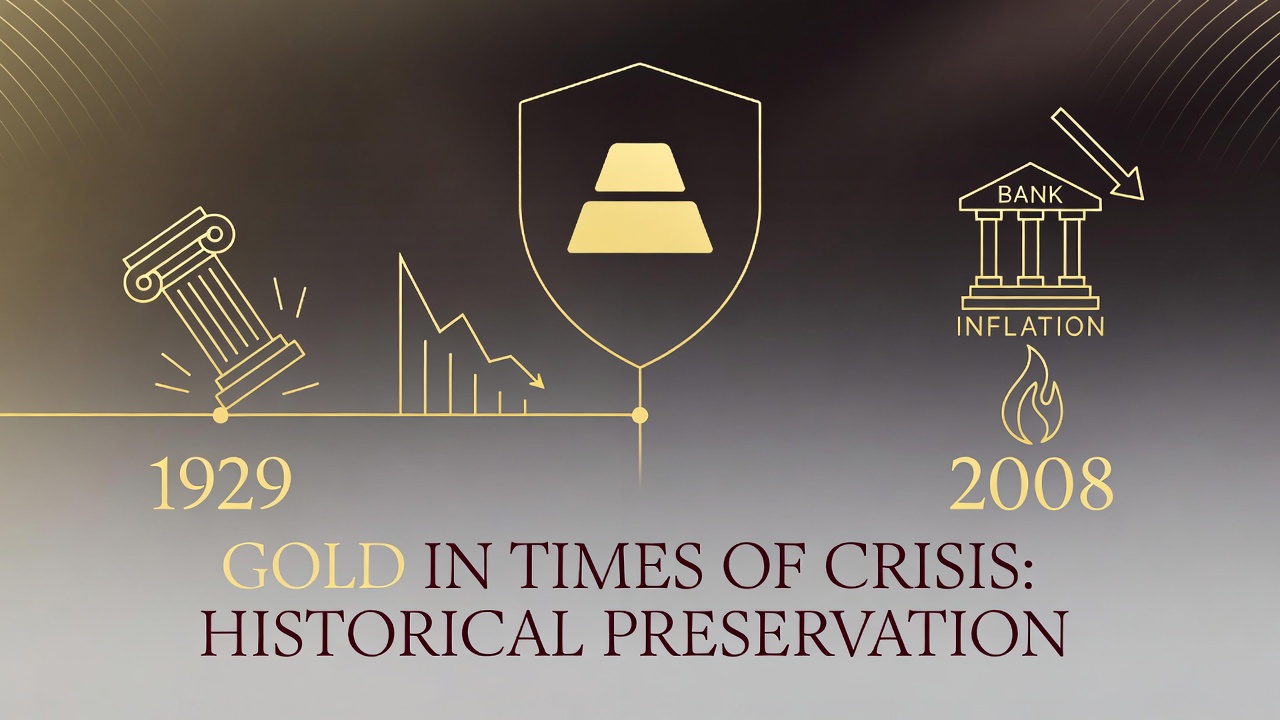
- Great Depression (1929–1939): Stock market crash, bank failures. US citizens were forced to sell gold to government (1933), but globally, gold holdings maintained real value while equities and banks suffered.
- World War II & Post-War: Occupied Europe saw gold hidden or smuggled—families survived by selling small amounts. Post-war, gold helped rebuild wealth amid currency resets.
Pattern: Extreme inflation or systemic failure drives demand for tangible, non-printable assets.
Modern Crises: 1970s Stagflation to 2008 and Beyond
- 1970s Oil Shocks & Stagflation: High inflation eroded bonds and cash; gold acted as a hedge against purchasing power loss.
- 2008 Financial Crisis: Banking system stress, equity drawdowns. Gold held relatively stable while many assets plunged—illustrating low/negative correlation in stress.
- COVID-19 & Supply Disruptions (2020): Uncertainty drove institutional and private demand; gold served as perceived safety amid unprecedented policy responses.
Pattern: Gold’s role strengthens when trust in financial intermediaries or fiat erodes—providing ballast rather than amplification of upside.
Historical Patterns Summary Table
| Crisis Type | Common Economic Impact | Gold’s Observed Behavior | Key Preservation Mechanism |
|---|---|---|---|
| Currency Debasement/Inflation | Purchasing power erosion | Relative value increase | Non-printable scarcity |
| War & Geopolitical Upheaval | Destruction, displacement | Portable wealth transfer | Physical, borderless |
| Banking/Financial Collapse | Credit freeze, asset fire sales | Stability or relative strength | No counterparty dependence |
| Systemic Uncertainty | Flight to safety | Increased demand as hedge | Universal recognition |
Lessons for Modern Disciplined Investors
- Treat gold as insurance, not speculation — History shows preservation in stress, not consistent outperformance in calm.
- Size modestly — Excessive allocation risks opportunity cost in growth periods.
- Secure storage is non-negotiable — Crises often involve mobility or seizure risk (see storage guide).
- Diversify forms — Physical for true independence; ETFs for liquidity.
- Behavioral discipline — Avoid buying in panic; use predefined rules (evaluation checklist).
Tie to risk management: Gold’s historical resilience complements productive assets—reducing drawdown severity in blended portfolios.
Final Thoughts
Gold’s performance in crises stems from what it is—not what others promise. When systems strain, its simplicity and independence shine. Use history to reinforce process: allocate thoughtfully, preserve securely, review systematically.
Related reading:
- The Evolution of Gold in Global Economies (previous)
- How Gold Has Functioned as Money Across Civilizations
- How Gold Fits into a Diversified Portfolio
- How to Store Gold Securely
Frequently Asked Questions
- Why does gold often hold value in crises?
No counterparty risk, scarcity, and universal trust when institutions weaken. - Did gold always protect wealth in every historical crisis?
Not perfectly—short-term volatility exists—but it frequently preserved real value better than alternatives. - What happened to gold during the Great Depression?
US citizens had to sell to government, but globally it maintained purchasing power amid bank failures. - How did gold behave in hyperinflation examples?
Retained or increased relative value as fiat collapsed (e.g., Weimar Germany). - Is gold a good hedge in wars?
Historically yes—portable and accepted across sides; many families survived by holding it. - What about modern crises like 2008?
Gold provided relative stability while equities and credit markets plunged. - Can gold lose value in a crisis?
Yes—liquidity squeezes or forced sales can cause temporary drops; long-term patterns favor preservation. - How much gold is “enough” for crisis protection?
Modest allocation (5–15%) as insurance—over-reliance risks growth drag. - Does history suggest physical over paper gold in crises?
Physical for maximum independence; paper forms can face counterparty issues. - What behavioral mistake do people make in crises?
Buying high in panic—history rewards those with predefined rules. - How does gold compare to cash in crises?
Cash can be inflated away or frozen; gold often holds real value. - Are there examples where gold failed to preserve wealth?
Rare outright failures—more often underperformance in strong recovery periods. - Should beginners prepare for crises with gold?
Yes—as part of diversification, not primary holding. - What crisis lesson applies most to portfolios today?
Low correlation in stress—gold complements equities for reduced volatility.
