Stocks and gold represent two fundamentally different paths in the investing landscape. Stocks provide ownership in businesses that generate earnings, pay dividends, and grow over time through innovation and economic expansion. Gold, by contrast, is a physical commodity valued for its scarcity, durability, and centuries-long role as a store of value and medium of exchange.
While both can form part of a disciplined portfolio, their behaviors diverge significantly across risk profiles, return mechanisms, and how they interact with each other (correlation). Understanding these differences helps investors make informed allocation decisions—whether building a beginner portfolio or refining a systematic strategy focused on compounding and risk management.
This guide examines gold vs stocks systematically: core characteristics, drivers of returns, risk dimensions, historical correlation patterns, portfolio implications, and behavioral considerations. The emphasis is on evergreen principles, not short-term outlooks.
Fundamental Nature: Ownership vs Store of Value
Stocks represent fractional ownership in companies. Their value derives from future cash flows—profits reinvested, dividends distributed, or growth through expansion. This productive nature ties stock performance to economic cycles, corporate earnings, management decisions, and broader market sentiment.
Gold lacks intrinsic cash flow. It produces no dividends or interest. Its value stems from physical properties (malleability, non-corrosiveness, rarity) and universal acceptance as a hedge against uncertainty, inflation pressures, and currency debasement. Demand comes from jewelry, industry (electronics, medicine), central banks, and investors seeking preservation.
This core distinction shapes everything else: stocks lean toward growth in expanding economies; gold toward stability and protection in challenging ones.
Return Drivers: Growth vs Preservation
Stocks historically deliver returns through:
- Capital appreciation from rising earnings and multiples.
- Dividend income (reinvested for compounding).
- Economic tailwinds (productivity gains, population growth).
Over long horizons, equities have compounded at rates reflecting business profitability—often outpacing inflation substantially in expansionary periods.
Gold’s returns arise primarily from:
- Changes in supply/demand balance (mining output vs jewelry/industrial/central bank buying).
- Macro factors (real interest rates, currency strength, geopolitical events).
- Its role as “insurance” during uncertainty.
Gold does not generate ongoing income, so its long-term performance hinges on preserving purchasing power rather than multiplying it through productivity.
In blended portfolios, stocks typically drive growth; gold contributes through relative stability.
Risk Profiles: Volatility and Drawdowns
Risk manifests differently.
Stocks exhibit higher short-term volatility due to earnings surprises, sentiment shifts, recessions, and leverage. Drawdowns can be deep (e.g., 30–50%+ in major bear markets), but recoveries often follow as businesses adapt.
Gold shows volatility too, driven by macro sentiment, but historically with shallower and shorter drawdowns in equity stress periods. It can experience prolonged sideways periods during strong growth environments.
Descriptive comparison:
| Aspect | Stocks (Equities) | Gold |
|---|---|---|
| Primary Risk Source | Business/earnings/market sentiment | Macro/geopolitical/demand shifts |
| Typical Volatility | Higher (15–20% annualized) | Moderate (10–15% annualized) |
| Drawdown Severity | Can exceed 50% in crises | Often 20–40%, shorter duration |
| Recovery Driver | Economic rebound/corporate profits | Safe-haven demand/liquidity |
Neither is “risk-free,” but stocks carry more company-specific and cyclical risk; gold more systemic uncertainty risk.
Correlation: The Diversification Key
Correlation measures co-movement. Long-term average between gold and broad stock indices hovers near zero to low positive—meaning they often move independently.
In calm bull markets, correlation can turn mildly positive as risk-on sentiment lifts both. During stress (e.g., recessions, inflation spikes, crises), it frequently drops to negative territory—gold holding or rising as equities decline.
This low/negative linkage in turbulent times underpins gold’s diversification value: it provides ballast when stocks falter, reducing overall portfolio volatility without fully sacrificing growth potential.
Patterns observed across decades show correlation strengthening temporarily in certain regimes but reverting to low levels over full cycles—supporting its complementary role.
Portfolio Implications: Complementary Roles
Stocks serve as the growth engine in most portfolios—driving compounding through reinvested earnings.
Gold acts as a stabilizer and hedge—smoothing returns, protecting against specific risks (e.g., inflation erosion, currency weakness), and enhancing resilience.
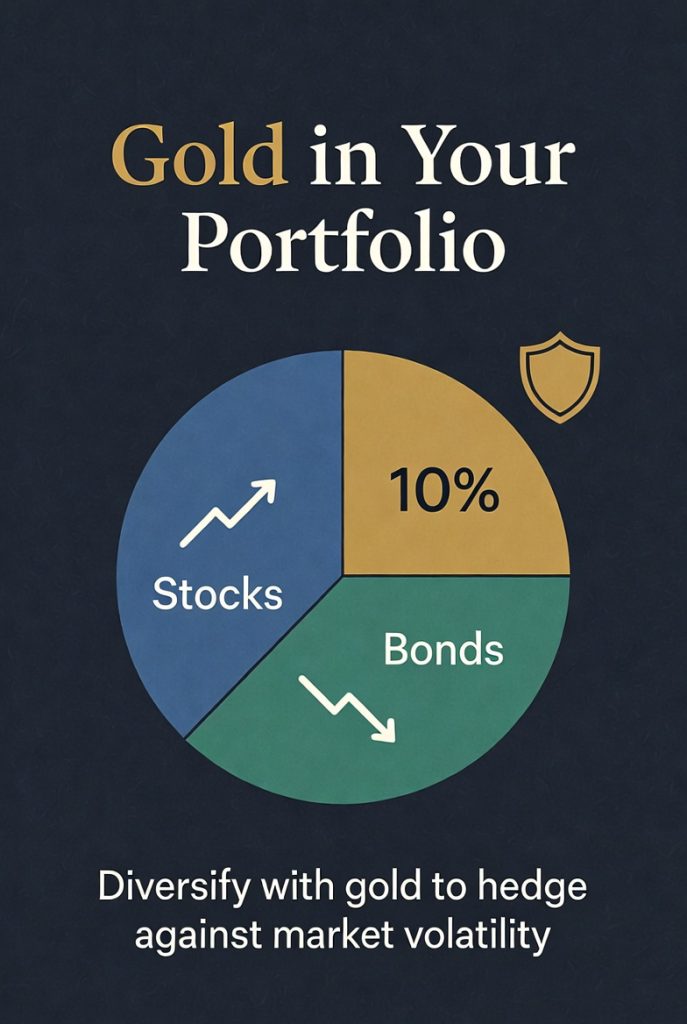
A blended approach (e.g., core equities with 5–15% gold) can improve risk-adjusted outcomes: similar long-term returns with lower volatility in many historical windows.
Tie to factor investing: Gold often exhibits defensive/low-volatility traits, pairing well with profitability or quality tilts by offsetting market beta exposure during drawdowns.
Behavioral and Practical Considerations
Investors often overweight stocks during euphoria (chasing returns) and abandon them in panic. Gold’s quieter nature can counter recency bias—reminding of preservation when growth narratives dominate.
Practical steps when comparing:
- Assess goals (growth vs protection).
- Evaluate time horizon (longer favors stocks’ compounding).
- Size allocations modestly for gold.
- Rebalance systematically.
Avoid emotional switches—use predefined rules.
Final Thoughts
Gold vs stocks boils down to growth vs preservation, higher volatility vs moderate stability, and often low correlation that enhances diversification.
For disciplined investors, neither “wins” outright—each serves a purpose. Stocks fuel long-term wealth building; gold safeguards it during uncertainty. Integrating both thoughtfully supports resilient portfolios focused on compounding and risk management.
Explore related topics:
- How Gold Fits into a Diversified Portfolio (previous article)
- Understanding Risk and Return
- Factor Investing: The Hidden Drivers
- How to Build Your First Diversified Portfolio as a Beginner
Frequently Asked Questions
- What is the biggest difference between gold and stocks?
Stocks offer ownership in productive businesses with growth and income potential; gold is a non-yielding store of value focused on preservation. - Which has higher long-term returns historically?
Stocks generally deliver higher compounded returns in expansionary periods due to earnings growth; gold excels at preserving purchasing power. - Is gold less risky than stocks?
Gold shows lower volatility and shallower drawdowns in many crises, but stocks carry recovery potential through business adaptation. - What is the typical correlation between gold and stocks?
Long-term average near zero to low positive, often turning negative during market stress for diversification benefit. - Can gold replace stocks in a portfolio?
No—gold lacks growth drivers; it complements rather than substitutes equities. - How does gold behave in bull markets for stocks?
It may lag or move sideways, creating opportunity cost if over-allocated. - Does gold provide income like stock dividends?
No—zero yield; returns depend on price appreciation from demand dynamics. - Why consider both in a beginner portfolio?
Stocks for growth/compounding; gold for stability and reduced overall volatility. - How does correlation change in recessions?
Frequently negative—gold often holds or rises while equities decline. - Is gold suitable as a core holding?
Better as a modest allocation (5–15%) for hedging rather than primary driver. - How does gold align with factor investing?
Displays defensive qualities, helping dampen drawdowns without diluting factor exposures like profitability. - What are the main risks of stocks vs gold?
Stocks: earnings disappointment, recessions; gold: prolonged underperformance in strong growth, storage/counterparty issues. - Should I choose one over the other?
No—systematic blending often improves risk-adjusted outcomes. - How to decide allocation between gold and stocks?
Based on risk tolerance, goals, and existing diversification—start small with gold as insurance.