
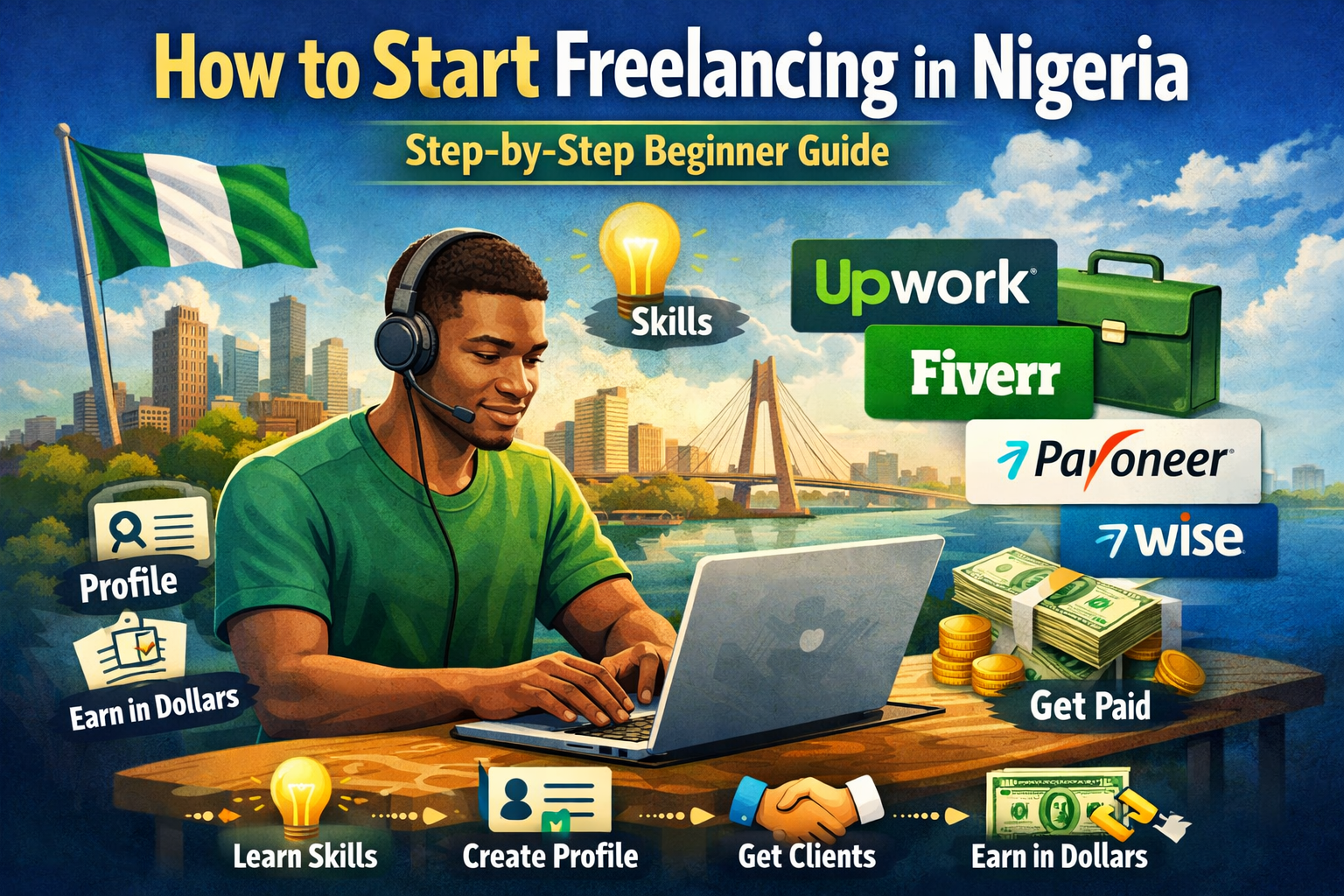
How to Start Freelancing in Nigeria (Step-by-Step 2026 Beginner Guide)
If you’ve ever thought about making money online in Nigeria, freelancing is one of the most realistic and accessible ways to start.
You don’t need to travel abroad. You don’t need a huge capital. And you don’t need to wait for a “perfect opportunity.”
All you need is:
- A skill
- Internet access
- Consistency
That’s it.
Today, thousands of Nigerians are earning in dollars through freelancing — writing, designing, programming, editing videos, managing social media, and more.
In this guide, I’ll walk you through everything step by step — not just how to start, but how to do it in a way that actually works.
Quick Summary
- Freelancing allows you to work online and earn in dollars
- You can start with little or no capital
- Platforms like Upwork and Fiverr connect you to clients
- Your success depends on skill, positioning, and consistency
What is Freelancing?
Freelancing simply means offering your skills as a service to clients — usually online — and getting paid for it.
Instead of working a fixed job, you work independently.
Examples of freelancing work:
- Writing articles
- Graphic design
- Web development
- Video editing
- Social media management
You don’t need to know everything. You just need to be good at something.
Why Freelancing is a Big Opportunity in Nigeria
Let’s look at reality.
The Nigerian economy is tough. Jobs are limited. Salaries are often low.
Freelancing changes that because:
- You earn in dollars
- You are not limited to Nigerian clients
- Your income is based on your skill, not location
For example:
A Nigerian freelancer earning $500/month is already earning more than many local salaries.
And it scales from there.
Step 1: Choose a Skill (This is the Foundation)
This is where many people get stuck — they overthink it.
You don’t need to learn everything. You need to choose one skill and focus.
High-Demand Freelance Skills
| Skill | Difficulty | Income Potential | Best For |
|---|---|---|---|
| Content Writing | Easy | Medium | Beginners |
| Graphic Design | Medium | High | Creative people |
| Web Development | Hard | Very High | Technical people |
Pick one. Focus on it. Improve it.
Step 2: Learn the Skill (Without Overcomplicating It)
You don’t need expensive courses to start.
You can learn from platforms like:
The mistake people make is learning forever without practicing.
Start practicing immediately.
Step 3: Create Your Freelance Profile
Now you need to position yourself where clients can find you.
Best platforms:
Your profile should:
- Clearly state your skill
- Show examples of your work
- Explain how you help clients
Step 4: Understand How You Will Get Paid
This is very important for Nigerians.
You need a way to receive your money.
Use platforms like:
Read this guide: How to Receive Dollar Payments in Nigeria
Step 5: Convert and Use Your Earnings
After receiving your money, you need to convert it properly.
Learn here: How to Convert USD to Naira in Nigeria
For online payments, use: Best Virtual Dollar Cards in Nigeria
Common Mistakes Beginners Make
- Trying to learn too many skills
- Giving up too early
- Not building a portfolio
- Ignoring client communication
Internal Strategy
To grow faster:
- Reinvest your earnings
- Improve your skill continuously
- Increase your rates gradually
How to Get Your First Freelance Job (Real Strategy)
This is where most beginners struggle — not because opportunities don’t exist, but because they approach it the wrong way.
Let’s be honest: the hardest part of freelancing is getting your first client.
But once you understand how it works, it becomes easier.
What Most Beginners Do Wrong
- They create a profile and wait
- They apply randomly without strategy
- They don’t personalize their proposals
This approach rarely works.
What Actually Works
To get your first job:
- Apply to small jobs (not big ones)
- Write simple, direct proposals
- Focus on solving the client’s problem
Example of a good approach:
Instead of saying:
“I am a professional freelancer with 5 years experience…”
Say:
“I understand you need help with X. Here’s how I can solve it…”
Clients care about results, not long grammar.
How to Price Your Services (Beginner to Pro)
Pricing is another area where many Nigerians get confused.
At the beginning, your goal is not to charge the highest rate — your goal is to build experience.
Stage 1: Beginner
- Charge low
- Focus on getting reviews
- Build portfolio
Stage 2: Intermediate
- Increase your rates gradually
- Be selective with clients
- Focus on quality
Stage 3: Advanced
- Charge based on value, not time
- Work with better clients
- Scale income
The mistake is trying to jump to Stage 3 immediately.
How Much Can You Realistically Earn?
This is the question everyone asks.
The answer depends on your skill, effort, and consistency.
| Level | Monthly Earnings | Experience | Focus |
|---|---|---|---|
| Beginner | $50 – $300 | 0–3 months | Learning & small jobs |
| Intermediate | $300 – $1,000 | 3–12 months | Consistency |
| Advanced | $1,000+ | 1+ year | Scaling |
This is realistic — not hype.
How to Build a Strong Freelance Profile
Your profile is your first impression.
A weak profile will get ignored, even if you are skilled.
What to Include
- Clear title (e.g., “Content Writer for SEO Blogs”)
- Simple description
- Portfolio samples
- Professional picture
Your goal is clarity, not complexity.
How to Scale Your Freelancing Income
Once you start earning, the next step is growth.
Here’s how to scale:
- Improve your skill
- Increase your rates gradually
- Focus on high-paying clients
- Build long-term relationships
Freelancing is not just about starting — it’s about growing.
Common Challenges Nigerians Face (And How to Handle Them)
- Payment issues: Use trusted platforms like Payoneer and Wise
- Conversion losses: Learn proper conversion methods How to Convert USD to Naira
- Payment failures: Use virtual cards Best Virtual Dollar Cards
Frequently Asked Questions (Detailed)
Can I start freelancing with no experience?
Yes, but you must be willing to learn quickly and practice consistently.
You don’t need to be perfect — you just need to be useful.
How long does it take to get your first client?
It depends on your effort and strategy.
Some people get their first job within weeks, while others take longer because they apply without direction.
Is freelancing stable?
Freelancing is not like a fixed job, but it can become stable over time if you build consistent income streams and client relationships.
Do I need a laptop?
For some skills, yes. But many people start with just a smartphone and upgrade later.
How do I avoid scams?
Always work through trusted platforms and avoid deals that look too good to be true.
Final Thoughts (Real Strategy)
Freelancing is one of the most practical ways to earn in dollars from Nigeria today.
But it is not magic.
You need:
- Consistency
- Patience
- Focus
If you stay consistent, improve your skill, and apply strategically, you can build a solid income over time.
Start small. Stay consistent. Improve continuously.
Next step: How to Receive Dollar Payments in Nigeria
