How to Start Investing in 2026: A Complete Beginner’s Guide
Why Start Investing in 2026?
In 2026, global markets continue to offer opportunities amid economic recovery, technological advancements, and evolving interest rates. Investing is a proven way to build long-term wealth, outpace inflation, and harness the power of compounding—regardless of your starting point.
Many beginners hesitate, thinking it requires large sums, expert knowledge, or perfect timing. The reality? You can begin with small amounts (even $10–$100), use simple, low-risk strategies, and grow steadily over time. This guide provides a step-by-step roadmap—from mindset to your first investment—so you can start confidently in 2026.
Key Benefits of Starting Now:
- Compounding Power: Small, consistent investments grow exponentially (e.g., $1,000 at a 10% annual return becomes about $2,590 in 10 years).
- Beat Inflation: Cash in savings accounts loses purchasing power; investments can grow faster.
- Accessibility: Modern apps and platforms make investing straightforward, with no minimums and educational tools built-in.
Step 1: Build the Right Mindset and Set Clear Goals
Investing success begins with the right approach. Treat it as a long-term habit, not a shortcut to riches.
Common Beginner Mindsets to Avoid:
- Fear of market drops → Volatility is normal; markets historically recover and trend upward.
- Chasing “hot” tips or trends → Stick to proven fundamentals.
- Waiting for the “perfect” moment → Consistent time in the market outperforms attempts to time it.
Define Your Goals (using the SMART framework):
- Specific: “Build a retirement fund” or “Save for a home down payment.”
- Measurable: “$50,000 in 15 years.”
- Achievable: Start with $50–$200 monthly.
- Relevant: Align with your life stage and priorities.
- Time-bound: Set deadlines (e.g., by age 50).
Actionable Exercise:
- List 3–5 goals.
- Use a free compound interest calculator (available on sites like Investor.gov or brokerage apps) to estimate growth.
Step 2: Assess Your Financial Foundation
Invest only what you can afford to leave invested long-term. Secure basics first to avoid selling during downturns.
Checklist:
- Emergency Fund: 3–6 months of living expenses in a high-yield savings account.
- Pay Off High-Interest Debt: Focus on credit cards or loans with rates >7–10% before aggressive investing.
- Budget Basics: Track income and expenses (use free apps like Mint or YNAB).
- Insurance: Ensure you have health, life, or disability coverage as needed.
How Much to Invest? Beginners often start with $50–$500. Adopt “pay yourself first”—automate transfers right after payday.
Step 3: Understand Key Investing Concepts
What is Investing? Allocating money to assets expected to grow in value over time (vs. saving, which preserves capital).
Main Asset Classes for Beginners:
- Stocks: Shares in companies (high growth potential, but volatile).
- Bonds: Loans to governments or corporations (more stable, lower returns).
- Mutual Funds/ETFs: Pooled investments tracking indexes or sectors (diversified and easy).
- Index Funds: Low-cost funds mirroring broad markets like the S&P 500 (historically strong performers for beginners).
Risk vs. Reward:
Higher returns come with higher risk. Beginners: Lean conservative (e.g., 60–80% stocks if young, more bonds if closer to goals).
Compounding Explained:
Formula: A = P(1 + r/n)^(nt)
Where A = final amount, P = principal, r = annual rate, n = compounding frequency, t = years.
Example: $5,000 at ~10% average annual return (historical S&P 500 including dividends) over 20 years grows to ~$33,600.
Historical note: The S&P 500 has averaged around 10% annually (including dividends) over long periods, though returns vary year to year (e.g., ~7% inflation-adjusted).
Step 4: Choose Your Investment Style
Passive vs. Active:
- Passive (ideal for beginners): Buy-and-hold low-cost index funds/ETFs → Minimal effort, low fees, historically outperforms most active strategies long-term.
- Active: Selecting individual stocks → Higher effort and risk.
Dollar-Cost Averaging (DCA): Invest fixed amounts regularly (e.g., $100 monthly) → Smooths out market timing risks.
Diversification: Spread investments across assets, sectors, and geographies to reduce risk.
Step 5: Open Your First Account (Broker/Platform)
Choose a beginner-friendly brokerage with $0 commissions, no minimums, educational resources, and intuitive apps.
Top Recommendations for Beginners in 2026 (based on ease, fees, tools, and reviews):
- Fidelity: Excellent education, research, and zero-fee funds.
- Charles Schwab: User-friendly, strong tools, great for practice.
- Vanguard: Pioneer of low-cost index funds.
- Robinhood: Simple app, commission-free, good for small starts.
- E*TRADE: Solid education and mobile experience.
Comparison Table:
| Platform | Min. Deposit | Best For | Fees (Stocks/ETFs) | Key Features for Beginners |
|---|---|---|---|---|
| Fidelity | $0 | Overall beginners | $0 | Deep education, fractional shares |
| Charles Schwab | $0 | Practice & long-term | $0 | Intuitive app, strong research |
| Vanguard | $0 (many funds) | Low-cost index investing | $0 | Broad ETF/index selection |
| Robinhood | $0 | Simple mobile trading | $0 | Easy interface, fractional shares |
| E*TRADE | $0 | Investor education | $0 | Learning resources, paper trading |
Steps to Open:
- Research and select a platform (check for your country’s availability).
- Sign up online/app (provide ID for verification).
- Fund via bank transfer or card.
- Explore demo/paper trading if offered.
Step 6: Make Your First Investment
Recommended Starter Portfolio for Beginners (Simple & Low-Risk):
- 70–80% in a broad stock index ETF (e.g., tracks S&P 500).
- 20–30% in bonds or total market funds for stability.
Example with $1,000:
- $700 → Vanguard S&P 500 ETF (VOO) or Fidelity ZERO Large Cap Index.
- $200 → Total bond market ETF (e.g., BND).
- $100 → International stock ETF for global exposure.
Implementation: Use DCA: Invest fixed amounts automatically monthly.
Tools: Track via brokerage apps, free sites like Yahoo Finance, or Google Sheets.
Step 7: Avoid Common Beginner Mistakes
- Investing money needed short-term.
- Panic-selling during market dips.
- Ignoring fees (even small ones compound negatively).
- Over-trading or chasing trends.
- Lack of diversification.
Focus on long-term holding and education.
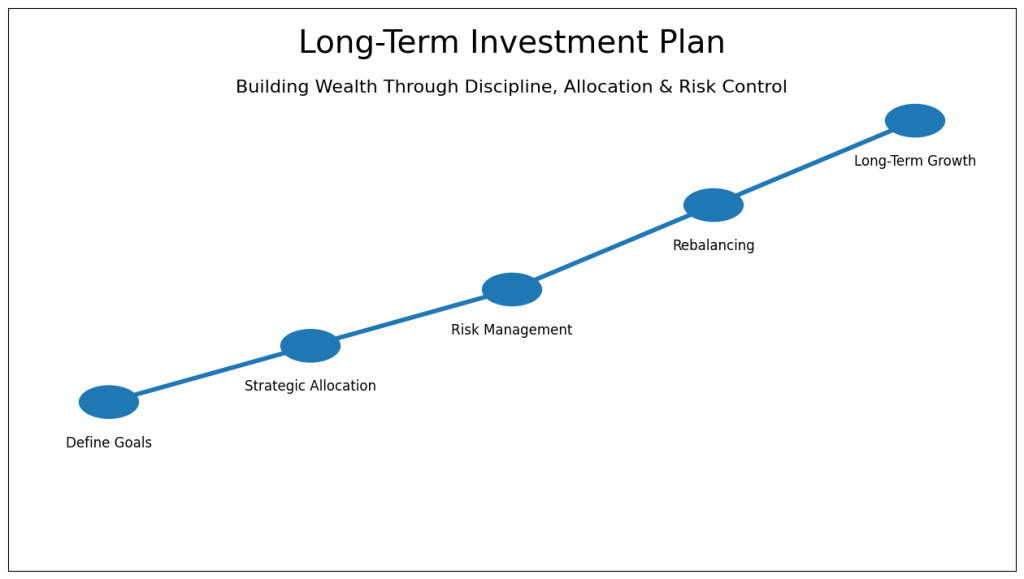
Step 8: Monitor, Rebalance, and Stay Consistent
Review quarterly (not daily to avoid emotional decisions). Rebalance annually to maintain allocation. Continue learning via books like “The Intelligent Investor” or free brokerage resources.
Resources:
- SEC Investor.gov for basics.
- Brokerage academies (Fidelity, Schwab).
- Communities like Reddit’s r/personalfinance or r/investing.
FAQs
How much do I need to start? As little as $1–$100 on many platforms (thanks to fractional shares).
Is the stock market safe in 2026? Long-term yes—historically recovers; short-term volatile.
Taxes? Varies by country; track gains/dividends (many platforms provide reports).
What if I lose money? Diversify, hold long-term—markets trend up over decades.
Conclusion
Starting in 2026 is about consistency, not perfection. Follow these steps, start small, and let compounding do the work. Your future self will thank you.