
Introduction
Financial markets are often described as rational systems driven by information, data, and economic fundamentals. In theory, traders and investors analyze available information, calculate probabilities, and make logical decisions that maximize expected returns.
In reality, human psychology plays a far greater role than many people realize.
One of the most powerful psychological forces influencing financial decision-making is loss aversion. This bias affects nearly every trader, from beginners to experienced professionals. It quietly influences how traders react to profits, losses, and uncertainty.
Loss aversion explains why traders often:
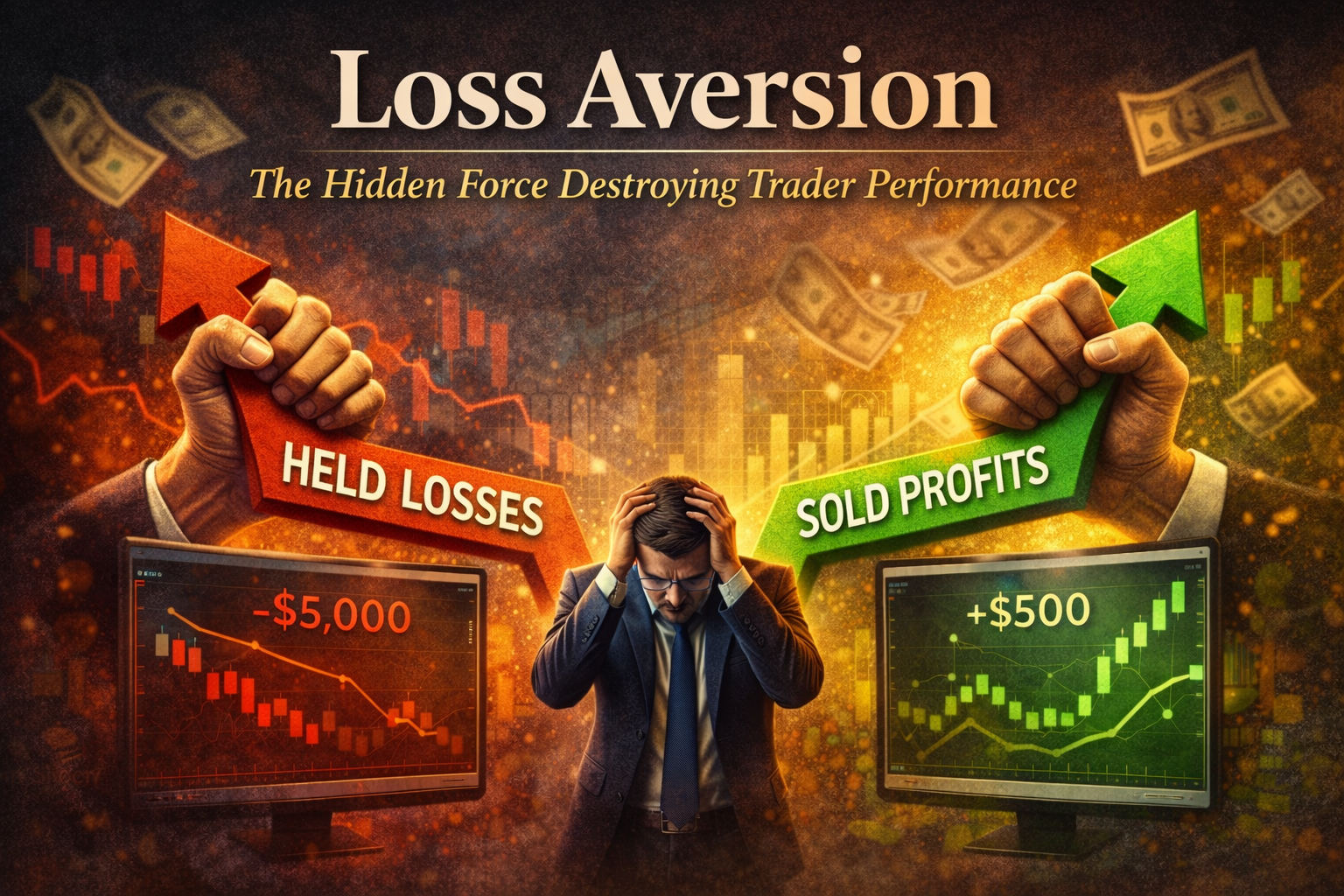
- Hold losing trades longer than they should
- Close profitable trades too quickly
- Refuse to accept small losses
- Allow small mistakes to grow into large losses
Understanding loss aversion is essential for anyone who wants to succeed in financial markets. Without recognizing this psychological bias, traders often sabotage their own strategies.
This article explores the concept of loss aversion, why it occurs, how it affects trading performance, and how disciplined traders learn to overcome it.
What Is Loss Aversion?
Loss aversion is a psychological bias in which people experience the pain of losses more strongly than the pleasure of equivalent gains.
In simple terms, losing money feels much worse than gaining the same amount feels good.
For example:
- Losing $100 often feels twice as painful as the satisfaction of gaining $100.
This concept was developed by Daniel Kahneman and Amos Tversky, two pioneering researchers in the field of Behavioral Finance.
Their research demonstrated that human decision-making is not perfectly rational. Instead, emotions and psychological biases strongly influence financial behavior.
Loss aversion is one of the central ideas behind Prospect Theory, which explains how people evaluate risk and reward under uncertainty.
Why Loss Aversion Exists
Loss aversion is deeply rooted in human evolution.
For most of human history, survival depended on avoiding danger rather than maximizing gains. Losing food, shelter, or resources could threaten survival, while gaining additional resources offered smaller immediate benefits.
As a result, the human brain evolved to treat losses as more urgent and emotionally intense than gains.
This survival mechanism worked well in prehistoric environments, but it creates problems in financial markets.
Trading requires the ability to accept small losses as a normal part of the process. However, the brain naturally resists realizing losses, leading to irrational decisions.
Loss Aversion in Trading Behavior
Loss aversion manifests in several common trading mistakes.
Refusing to Close Losing Trades
One of the most common consequences of loss aversion is the refusal to close losing positions.
Instead of accepting a small loss, traders often hope the market will reverse. This hope can lead to increasingly large losses.
For example:
A trader buys a stock at $100.
The price falls to $95.
Instead of exiting the trade according to the plan, the trader tells themselves:
“It will come back.”
Unfortunately, markets do not always recover quickly. What begins as a small loss can grow into a much larger one.
Taking Profits Too Quickly
Loss aversion also affects how traders manage profitable trades.
Because traders fear losing existing profits, they often close winning trades prematurely.
Consider this example:
A trader enters a position that quickly rises by 5%. Instead of allowing the trade to develop according to the strategy, the trader exits early to “lock in” profits.
While this behavior feels emotionally comfortable, it can destroy the long-term profitability of a trading system.
Many successful strategies rely on letting winners run while cutting losses quickly.
Moving Stop Losses
Another dangerous behavior caused by loss aversion is moving stop losses.
A stop loss is designed to limit risk by automatically exiting a trade when a predetermined price level is reached.
However, when prices approach the stop loss, traders sometimes move it further away.
This behavior transforms a controlled loss into an uncontrolled one.
Professional traders rarely move stop losses unless there is a valid strategic reason to do so.
The Disposition Effect
Loss aversion also contributes to a well-known behavioral pattern called the Disposition Effect.
The disposition effect describes the tendency of investors to:
- Sell winning investments too quickly
- Hold losing investments for too long
This behavior has been observed across many financial markets, including stocks, cryptocurrencies, and commodities.
Studies show that investors often realize profits quickly but delay realizing losses.
This pattern reduces overall investment performance.
Why Loss Aversion Destroys Trading Systems
Many trading strategies are built around a simple principle:
Small losses + large gains = long-term profitability.
However, loss aversion reverses this equation.
Instead of accepting small losses, traders allow losses to grow larger. At the same time, they close winning trades early.
The result becomes:
Large losses + small gains = long-term losses.
Even the best trading strategy cannot succeed under these conditions.
This is why psychological discipline is as important as strategy design.
Professional Traders and Loss Acceptance
Successful traders approach losses differently.
Instead of viewing losses as personal failures, they treat them as normal business expenses.
Every trading strategy has losing trades. Even highly profitable strategies can experience long sequences of losses.
Professional traders understand this statistical reality.
They focus on executing their strategy consistently rather than trying to avoid every loss.
Risk Management as a Psychological Tool
Risk management is one of the most effective ways to reduce the emotional impact of loss aversion.
Many professional traders follow strict risk rules such as:
- Risking only 1–2% of capital per trade
- Using predetermined stop losses
- Avoiding oversized positions
These rules ensure that individual losses remain manageable.
When losses are small, the emotional pressure decreases, making it easier to follow the trading plan.
The Role of Probabilistic Thinking
Another way professional traders overcome loss aversion is by thinking in terms of probabilities rather than individual outcomes.
This mindset was popularized by trading psychologist Mark Douglas.
Instead of focusing on the outcome of a single trade, traders evaluate performance across many trades.
For example:
A trading system may win only 50% of the time but still generate strong profits if the average win is larger than the average loss.
By viewing trading as a long-term probability game, traders reduce the emotional impact of individual losses.
Practical Techniques for Overcoming Loss Aversion
Overcoming loss aversion requires deliberate psychological training.
1. Use Predefined Stop Losses
Always determine the exit point before entering a trade.
Once the trade is active, the stop loss should rarely be moved.
2. Risk Small Amounts
Keeping risk small reduces emotional stress and improves decision-making.
3. Track Performance with a Trading Journal
Recording trades helps traders identify emotional patterns that affect decision-making.
4. Focus on Process Instead of Outcome
Evaluate trading performance based on whether the strategy was followed correctly, not on whether a trade was profitable.
5. Accept That Losses Are Inevitable
Losses are a natural part of trading. Accepting this reality is essential for long-term success.
The Long-Term Advantage of Emotional Discipline
Traders who successfully manage loss aversion gain a powerful advantage.
While many traders make emotional decisions, disciplined traders follow structured processes.
Over time, this difference compounds into significant performance gaps.
Markets reward consistency and discipline far more than short-term emotional reactions.
Conclusion
Loss aversion is one of the most powerful psychological biases affecting traders and investors.
Because losses feel more painful than gains feel rewarding, traders often make irrational decisions that damage long-term performance.
They hold losing trades too long, close profitable trades too quickly, and resist accepting small losses.
Successful traders recognize this psychological bias and design systems that prevent emotions from controlling their decisions.
By using disciplined risk management, probabilistic thinking, and structured trading plans, traders can reduce the influence of loss aversion and improve their long-term results.
In financial markets, success rarely comes from eliminating losses entirely.
Instead, success comes from accepting small losses while allowing profitable trades to grow.
Related Articles
- Behavioral Finance: Why Investors Aren’t Always Rational
- Modern Portfolio Theory Explained: Risk, Diversification, and Portfolio Construction
- Momentum Investing: Why Winning Stocks Often Keep Winning
- Market Anomalies: When Financial Markets Behave Irrationally
Frequently Asked Questions
What is loss aversion in trading?
Loss aversion is a psychological bias where traders experience the pain of losses more strongly than the pleasure of equivalent gains.
Why do traders hold losing trades too long?
Many traders hold losing trades because closing the position would force them to realize the loss emotionally.
Can loss aversion be eliminated?
It cannot be completely eliminated, but it can be managed through risk management, discipline, and structured trading systems.
Do professional traders experience loss aversion?
Yes. Even experienced traders experience it, but they design trading systems that limit emotional decision-making.
How can traders reduce emotional trading mistakes?
Using trading plans, predefined stop losses, risk limits, and journaling helps reduce emotional mistakes.
[…] This behavior is explored in loss aversion in trading. […]