
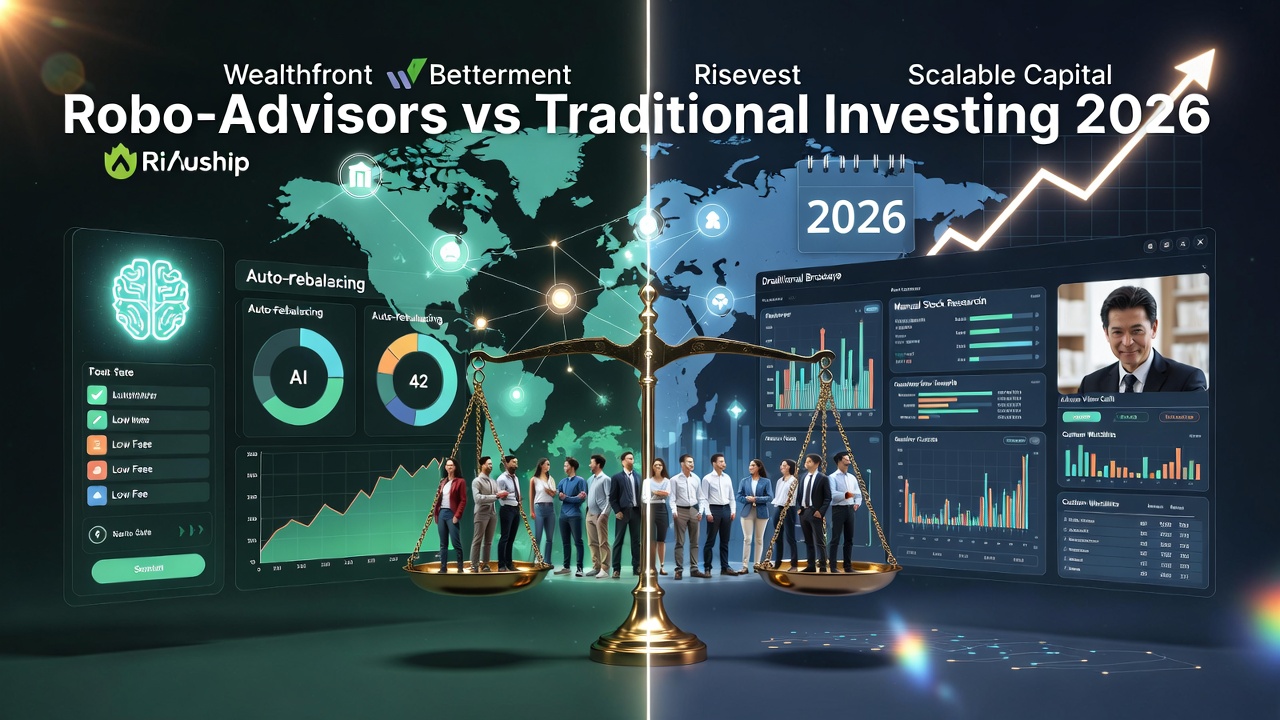
Robo-Advisors vs Traditional Investing 2026: Global Comparison, Best Platforms & Beginner Analytics
In 2026, investors worldwide face a clear fork: hand over portfolio management to algorithms via robo-advisors, or maintain full control through traditional brokers, financial advisors, and self-directed accounts. With global equity markets still delivering 8–12% long-term nominal returns (despite short-term volatility), low-cost automation has democratized access while traditional methods retain advantages in customization and complex needs. IMF projects steady 3.3% world growth, making consistent investing more important than ever — but the right vehicle determines how much you keep.
This guide delivers a balanced, data-driven comparison of robo-advisors vs traditional investing in 2026. We analyze fees, performance, features, tax efficiency, global availability, real user experiences across US, Europe, Asia, Latin America, Africa & diaspora, hybrid approaches, step-by-step decision frameworks, platform rankings, risk considerations, and 10–20 year projections. Whether you’re in Abuja starting with $500, Berlin scaling to six figures, or São Paulo diversifying globally, you’ll finish knowing exactly which path (or combination) maximizes your after-fee, after-tax returns.
Robo-Advisors vs Traditional Investing: 2026 Core Comparison
| Factor | Robo-Advisors 2026 | Traditional Investing 2026 | Winner (Beginner Perspective) |
|---|---|---|---|
| Fees (AUM) | 0.15–0.45% (most 0.25%) | 0% (self-directed) to 1–2% (advisor) | Robo (dramatic savings) |
| Minimum Investment | $0–$5,000 (most $0–$500) | $0 (brokerage) to $100k+ (advisor) | Tie (both accessible) |
| Customization | Limited (risk sliders, ESG, tax-loss harvesting) | Full control (individual stocks, sectors, timing) | Traditional |
| Behavioral Coaching | Automated (stay invested alerts, glide paths) | Self or advisor-dependent | Robo |
| Tax Optimization | Automated harvesting (US), limited elsewhere | Manual or advisor-managed | Robo (US); Traditional (complex cases) |
| Global Access | Improving (some offer intl ETFs) | Full via IBKR, eToro, local brokers | Traditional |
| Performance (After Fees) | Matches market minus tiny fee | Market minus fees + skill (or minus mistakes) | Robo (consistency) |
Top Robo-Advisor Platforms 2026 – Global Ranking
| Platform | Primary Regions | AUM Fee | Minimum | Standout Features 2026 | Best For |
|---|---|---|---|---|---|
| Wealthfront (US) | US residents | 0.25% | $500 | Best-in-class tax-loss harvesting, direct indexing | US high-net-worth beginners |
| Betterment (US) | US residents | 0.25% (Digital) / 0.40% (Premium) | $0 | Crypto exposure, human advisors at higher tier | US beginners wanting flexibility |
| Vanguard Digital Advisor (US) | US residents | 0.15–0.20% | $3,000 | Ultra-low cost, Vanguard fund focus | Cost-obsessed US investors |
| Risevest / Bamboo (Africa) | Nigeria & diaspora | 0.5–1.5% + fund fees | Low ($10+) | USD access, fractional US stocks/ETFs | African beginners wanting global exposure |
| Nutmeg / Moneyfarm (Europe) | UK/EU | 0.45–0.75% | £500–€1,000 | Socially responsible options, strong UI | European hands-off investors |
| Scalable Capital / Trade Republic (Europe) | Germany/EU | 0–0.99€/trade or 0.75% | €1+ | Fractional shares, low-cost ETFs | Cost-conscious Europeans |
Performance Reality Check 2026: Robo vs Traditional
After-fee returns: Robo-advisors match or slightly beat average traditional self-directed investors due to lower costs and behavioral coaching. Dalbar studies consistently show retail investors underperform indices by 3–5% annually from poor timing — robos mitigate this.
2026 edge cases:
- Robo wins for beginners (discipline, low fees, auto-rebalancing)
- Traditional wins for advanced needs (individual stock picking, options, complex tax situations)
- Hybrid wins for many: robo core portfolio + traditional satellite for speculation/custom needs
Global Accessibility & Restrictions 2026
US Residents: Wealthfront/Betterment/Vanguard Digital dominant; some offshore restrictions.
Europe: Nutmeg, Moneyfarm, Scalable Capital, Trade Republic; MiFID II regulations standardize protection.
Africa & Diaspora: Risevest/Bamboo/Chaka lead for USD/global access; local brokers still strong for domestic stocks.
Asia: StashAway (Singapore), Endowus (Singapore), Syfe (Singapore/HK), Zerodha Coin (India robo-like).
Latin America: Fintual (Chile/Mexico), GBM (Mexico), local brokers with robo features.
Step-by-Step Decision Framework for 2026
- Assess Your Profile (Week 1): Experience level, time available, portfolio size, complexity needs, tax situation.
- Determine Core vs Satellite (Week 2): 70–90% core (set-and-forget) → robo/index; 10–30% satellite → traditional/active.
- Compare Platforms (Month 1): Fees, minimums, global access, tax features, UI for your region.
- Start Small & Test (Months 1–3): Fund $500–$5,000; monitor 3–6 months.
- Hybridize & Scale (Ongoing): Add traditional tools as portfolio/knowledge grows.
| Investor Type | Recommended Path 2026 | Primary Platform Examples | Expected After-Fee Return Advantage |
|---|---|---|---|
| True Beginner ($0–$50k) | Robo 100% | Risevest, Betterment, Scalable Capital | +1–3% vs self-directed mistakes |
| Intermediate ($50k–$250k) | Robo core + traditional satellite | Wealthfront + IBKR or local broker | Balanced discipline + flexibility |
| Advanced/High-Net-Worth | Traditional primary + robo efficiency | Advisor/IBKR + Vanguard Digital overlay | Customization outweighs small fee difference |
Real User Experiences 2025–2026
Nigeria Diaspora (Risevest + Bamboo): $18k invested 2024 → $21.5k by March 2026 (~19% return) with dollar hedge; “set it and forget it” beats manual trading losses.
US Beginner (Betterment): $45k portfolio auto-rebalanced through 2025 dip → outperformed self-directed friends by 4% due to no panic selling.
Germany Intermediate (Scalable Capital): €120k in diversified ETFs → 0.99€/trade model + fractional shares → lower cost than old bank advisor (1.2% AUM saved).
Brazil Advanced (Fintual + GBM): Hybrid robo core + stock picks → beat benchmark by 3% while robo handled 70% passively.
Risks & Limitations 2026
Robo Risks: Black-box algorithms, limited customization, potential over-reliance on models during anomalies.
Traditional Risks: Behavioral mistakes, higher fees (if advisor), time commitment.
Global Risks: Platform availability (some block non-residents), currency conversion fees, regulatory changes.
Long-Term Mindset & Decision Framework
Robo-advisors excel at removing emotion and fees; traditional investing rewards knowledge and discipline. Most successful long-term investors end up hybrid: robo for core, traditional for satellite/opportunistic plays. Start where you are — test both with small amounts. Re-evaluate every 12–24 months as portfolio grows. Read: “The Intelligent Asset Allocator” (Bernstein), “A Random Walk Down Wall Street” (Malkiel). Focus on behavior + low costs = winning formula regardless of vehicle.
FAQs
- Do robo-advisors beat traditional investing long-term? After fees and behavior, yes for most beginners; traditional can outperform with skill/luck.
- Best robo-advisor for Africans in diaspora 2026? Risevest/Bamboo for dollar access; Wealthfront/Betterment if US-eligible.
- Are robo fees worth it? Yes — 0.25% vs 1–2% advisor or behavioral underperformance (3–5% annual gap).
- Can I combine robo and traditional? Absolutely — most high-net-worth do exactly this.
- Do robo-advisors work in bear markets? Yes — auto-rebalancing buys low; behavioral coaching prevents selling panic.
- Global ETF access on robo platforms? Improving; US platforms best, Africa platforms catching up fast.
- Tax-loss harvesting worth it? Yes — can add 0.5–1% annualized return in taxable accounts (US mainly).
- Will AI make robo-advisors even better by 2030? Almost certainly — personalization and dynamic allocation advancing rapidly.
- Best for hands-off Europeans? Scalable Capital, Trade Republic, Nutmeg — low fees + strong regulation.
- Security concerns with robo platforms? Regulated platforms (SEC, FCA, etc.) have SIPC/FSCS protection up to limits.
- How to choose in 2026? Prioritize: fees → global access → tax features → UI → human support if needed.
- Start today? Open Risevest/Betterment/Scalable account → fund $100–$1,000 → set risk level → automate monthly.
Related Articles
- The Ultimate Guide to Index Fund Investing in 2026
- Best Passive Income Ideas for 2026
- FIRE Movement 2026 Explained
- Global Tax Optimization for Investors 2026
- Compound Interest Mastery 2026
Motivational Conclusion
Whether you choose the elegant automation of robo-advisors or the hands-on control of traditional investing, 2026 gives you more powerful, lower-cost tools than any previous generation to build lasting wealth. The real edge isn’t the platform — it’s consistency, low fees, global diversification, and behavior management over decades. From Abuja to Austin, Berlin to Brasília, investors who start small, stay invested, and keep costs minimal are quietly winning the long game. You don’t need to pick the “perfect” method — you just need to pick one, start today, and let compounding do the rest. Your future financially-free self is already on the other side of this decision.
Call-to-Action: Which approach feels right for you right now — full robo, full traditional, or hybrid? And what’s your first step this week (opening Risevest, funding Betterment, researching Scalable Capital, etc.)? Share in the comments — let’s help each other choose wisely in 2026. Take that first action today — your portfolio’s future growth is waiting.
