
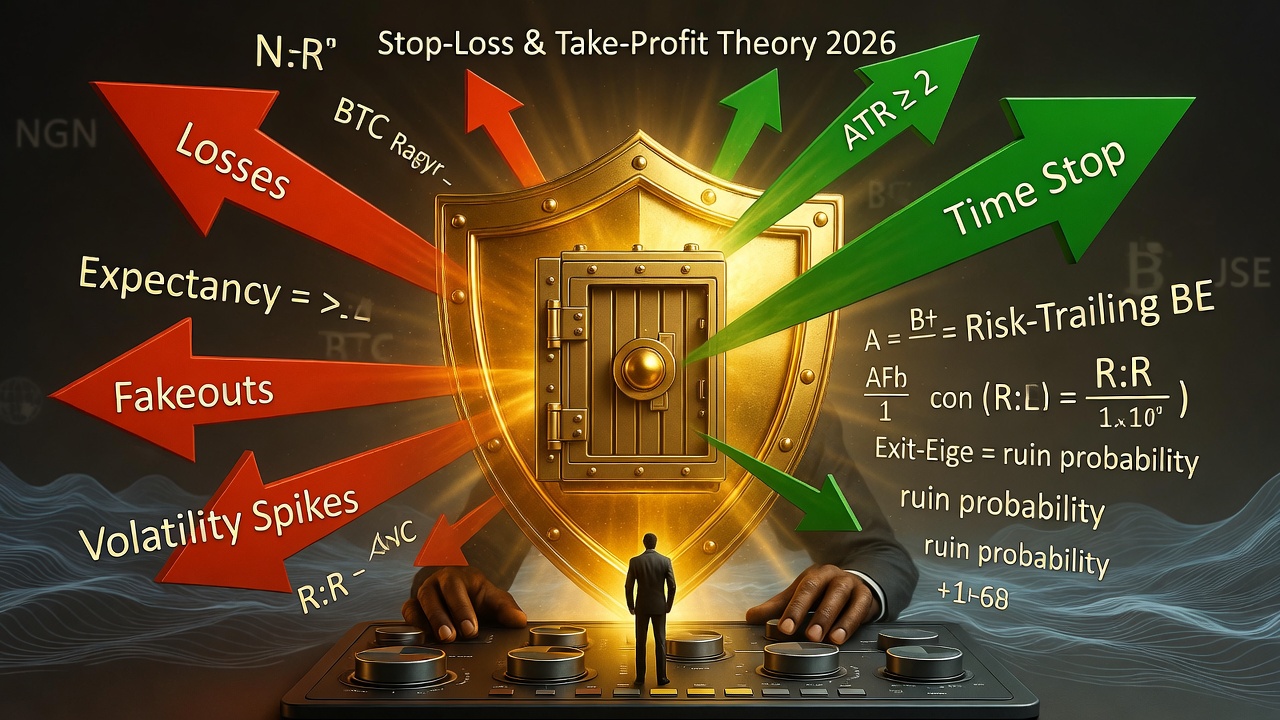
Stop-Loss & Take-Profit Theory 2026: ATR Multiples, Time Stops, Volatility Bands & Optimal Placement Math Without Charts
Stop-loss and take-profit placement is the invisible line between survival and ruin in trading. In 2026, with elevated volatility across USD/NGN (policy-driven swings), crypto (Bitcoin 30–60% drawdowns still normal), NGX/JSE equities (election and reform shocks), and commodities (oil/geopolitical spikes), incorrect exits turn positive-expectancy strategies into consistent losses. Too tight stops get hunted in noise; too wide stops let winners turn into losers or blow up accounts during regime shifts.
This deep theoretical and quantitative guide dissects every major stop-loss and take-profit method used by retail and professional traders in 2026: ATR multiples, volatility bands, time-based stops, support/resistance logic, percentage-based, breakeven trailing, optimal placement math, expectancy impact formulas, psychological trade-offs, regime dependence, Nigerian/African market realities (NGN pairs, diaspora USD trading), and step-by-step decision frameworks. No charts — just pure logic, math, survival tables, and 2026 context to help you exit trades with discipline, protect capital, and let winners run where the regime allows.
Why Exit Rules Matter More Than Entries in 2026
A 55% win-rate strategy with 1:2 risk-reward can produce strong compounding — but only if losers are capped small and winners are allowed to run. Historical data across markets shows:
- Retail traders average 1.5–2× larger losses than wins due to poor stop placement and early profit-taking.
- In high-vol regimes (crypto 2025–2026, USD/NGN policy shocks), fixed-percentage stops get triggered prematurely → expectancy collapses.
- In trending regimes (BTC halving runs, oil geopolitical spikes), trailing stops or time-based exits capture multi-R winners.
- Nigerian traders face extra friction: NGN conversion costs, platform liquidity gaps, and policy interventions → exits must account for slippage and fakeouts.
Core principle: Entries get you in the game — exits determine if you stay in the game. In 2026’s regime-shifting, news-heavy environment, disciplined exits are survival.
The Mathematics of Stop-Loss & Take-Profit Placement
1. Expectancy Impact Formula
E = (Win% × Avg Win R) – (Loss% × Avg Loss R)
Changing stop distance directly affects Win%, Avg Loss R, and Avg Win R → expectancy can swing from negative to strongly positive.
2. Breakeven Win Rate Required
Breakeven Win% = Risk / (Risk + Reward)
Example: 1% risk, 3% target → breakeven win rate = 1 / (1 + 3) = 25%. Lower risk or higher reward lowers required win rate.
3. Ruin Probability with Tight vs Wide Stops
Tight stops → higher win rate but smaller R:R → geometric ruin risk if win rate drops. Wide stops → lower win rate but larger R:R → ruin risk if streak hits.
Major Stop-Loss & Take-Profit Methods – Deep Breakdown 2026
1. ATR Multiples (Volatility-Adjusted Stops)
Stop = Entry ± (ATR × Multiplier)
Take-Profit = Entry ± (ATR × Reward Multiplier)
Typical 2026 Multipliers:
- Forex majors (EUR/USD): 1.5–2.5× ATR stop, 3–5× ATR target
- USD/NGN: 2–4× ATR stop (higher vol), 4–8× ATR target
- Crypto (BTC): 2–5× ATR stop, 6–12× ATR target
- NGX/JSE equities: 1.8–3× ATR stop, 4–7× ATR target
Expectancy Table – ATR Sizing (1% risk per trade)
| Market | ATR Multiple Stop | Reward Multiple | Typical Win Rate | Expectancy per Trade |
|---|---|---|---|---|
| EUR/USD | 2× ATR | 4× ATR | 45–55% | +0.35–0.65R |
| USD/NGN | 3× ATR | 6× ATR | 40–50% | +0.40–0.80R |
| Bitcoin | 4× ATR | 10× ATR | 35–45% | +0.75–1.50R |
2. Time-Based Stops
Exit if trade not profitable after X bars/time (e.g., 5 days, 20 candles).
2026 Edge: Prevents capital tie-up in dead trades (common in USD/NGN ranges, NGX quiet periods).
Math: Reduces average loss size → increases expectancy if win rate holds.
3. Volatility Bands / Envelope Stops
Stop = Entry ± (Moving Average ± Volatility Band)
2026 Use: Adaptive to regime — tight in low-vol, wider in high-vol (crypto corrections, oil spikes).
4. Breakeven Trailing & Profit Protection
Move stop to breakeven after X R profit → protects capital while letting winners run.
Math Impact: Increases average win size → boosts expectancy significantly in trending regimes.
Regime Dependence & 2026 Placement Recommendations
| Regime / Market | Recommended Stop Method | Take-Profit Method | Typical Risk Multiple |
|---|---|---|---|
| Range-Bound Forex (USD/NGN) | 2–3× ATR or time stop | Opposite band / 3–5× ATR | 1–1.5% |
| Trending Crypto (BTC) | 4–6× ATR trailing | No fixed TP — trail | 0.5–1% |
| NGX/JSE Equities | 2.5× ATR or below recent low | 3–6× ATR or resistance | 0.75–1.5% |
| Geopolitical Commodities (Oil/Gold) | 3–5× ATR | Trailing or macro target | 1–2% |
Psychological & Practical Trade-Offs 2026
Tight Stops: Frequent small losses → feels “always stopped out” → revenge trading risk.
Wide Stops: Larger losses → feels “holding losers forever” → hope bias.
Trailing Stops: Protects profits → but whipsaws in choppy regimes → premature exits.
2026 insight: USD/NGN policy ranges demand tight/time stops; crypto trends demand wide/trailing stops.
Step-by-Step Exit Placement Framework 2026
- Determine Regime (Pre-Entry): Range-bound → tight ATR/time stop. Trending → wide ATR trailing.
- Set Initial Stop: 1–2% portfolio risk → calculate ATR multiple that fits.
- Set Take-Profit: 2–4× initial risk (mean reversion) or no fixed TP (trend following).
- Adjust for Slippage/Liquidity: Add buffer in low-liquidity markets (NGX, crypto weekends).
- Protect Breakeven: Move to BE after 1–2R profit in trending setups.
- Review Post-Trade: Did stop placement match regime? Tweak multiplier next time.
FAQs
- What is the best stop-loss method for USD/NGN in 2026? 2–4× ATR or time-based (5–10 days) — policy ranges cause frequent fakeouts.
- Should beginners use tight or wide stops? Start with 1–1.5% risk via 2–3× ATR — wide enough to breathe, tight enough to survive streaks.
- Does trailing stop always improve expectancy? No — great in trends, terrible in ranges (whipsaws kill winners).
- How to set take-profit in crypto trends? No fixed TP — trail with 4–6× ATR or parabolic SAR logic.
- What is the biggest mistake with stop placement? Setting stops based on “hope” or round numbers instead of volatility/regime.
- Can time stops replace price stops? Yes in low-vol ranges (NGX quiet, USD/NGN policy) — frees capital faster.
- How does slippage affect stop placement in Nigeria? Add 10–20% buffer on NGX/crypto — platforms like Risevest/Bamboo can widen effective stop.
- Best take-profit for mean reversion? Opposite volatility band or 3–5× ATR — captures range extremes.
- 2026 markets most sensitive to stop hunting? Crypto futures, low-liquidity crypto alts, USD/NGN during CBN interventions.
- How to test stop placement without charts? Backtest expectancy with different multiples — calculate win rate and avg R:R impact.
- Where to start today? On your next setup, calculate 1% portfolio risk, set stop at 2–3× ATR (or time-based), target 3–5× ATR, enforce it strictly in demo or live.
- Is breakeven trailing always good? Yes in trends — protects capital; no in ranges — kills winners prematurely.
Related Articles
- Position Sizing Mastery 2026
- Mean Reversion vs Trend Following 2026
- Trading Discipline in 2026
- Risk Management for Beginners 2026
Motivational Conclusion
Stop-loss and take-profit placement isn’t about being right — it’s about surviving long enough to be right often enough. In 2026’s volatile, macro-driven markets — from USD/NGN policy ranges in Lagos to Bitcoin trends worldwide — disciplined exits turn average edges into compounding machines. You don’t need perfect entries — you need exits that protect capital, let winners breathe, and match the regime. Every trade’s exit rule is a vote for your long-term survival. Cast it wisely, enforce it ruthlessly, and let time reward your discipline. Your next trade’s exit is calling. Place it right — thrive tomorrow.
Call-to-Action: What’s your default stop-loss method right now (ATR multiple, time-based, percentage), and how will you adjust it based on the current regime of your main market? Share in the comments — let’s build a community of exit-smart traders. On your next setup, calculate 1% risk, set stop/take-profit using one method from this guide, and enforce it strictly. Exit right — edge compounds.
