
Introduction: Why CAPM Matters
Imagine you’re evaluating two stocks:
- Stock A: Expected return = 12%
- Stock B: Expected return = 8%
Which one is better?
Most beginners immediately choose 12%. But finance doesn’t work that way.
The real question is:
How much risk are you taking to earn that return?
This is where the Capital Asset Pricing Model (CAPM) becomes one of the most powerful tools in finance.
CAPM answers a fundamental investing question:
What is the fair expected return for a stock given its level of risk?
It builds directly on Modern Portfolio Theory (MPT) and introduces one of the most important concepts in finance:
Systematic risk (Beta).
In this complete beginner deep dive, you will learn:
- The economic intuition behind CAPM
- The full mathematical formula
- What Beta really measures
- How to calculate expected return step-by-step
- How investors use CAPM in real life
- The assumptions behind the model
- Criticisms and limitations
- How CAPM connects to valuation and cost of capital
By the end, you’ll understand why CAPM is still taught in universities and used in corporate finance globally.
1. The Big Idea Behind CAPM
Before CAPM, investors struggled with a major question:
If risk increases, how much additional return should I demand?
Modern Portfolio Theory already taught us something powerful:
- Diversification reduces company-specific risk.
- Investors should only be rewarded for risk that cannot be diversified away.
CAPM takes this one step further and says:
The only risk that matters is market risk.
In other words:
- You are NOT rewarded for taking risks that you could have diversified away.
- You ARE rewarded for exposure to overall market movements.
This idea changed finance forever.
2. Understanding Risk: Systematic vs Unsystematic
To fully understand CAPM, we must clearly distinguish between two types of risk.
2.1 Systematic Risk (Market Risk)
Systematic risk affects the entire market.
Examples:
- Recessions
- Inflation
- Interest rate hikes
- Geopolitical instability
- Global financial crises
This risk cannot be diversified away.
Even if you hold 100 different stocks, if the economy crashes, most stocks will fall.
CAPM says:
Investors must be compensated for systematic risk.
2.2 Unsystematic Risk (Company-Specific Risk)
Unsystematic risk is unique to a company.
Examples:
- Poor management decisions
- Product failure
- Lawsuits
- Fraud
- Weak earnings report
This risk can be diversified away.
If you own many stocks, one company failing won’t destroy your entire portfolio.
CAPM makes a bold claim:
Investors are NOT compensated for unsystematic risk.
Why?
Because rational investors can eliminate it through diversification.
3. The CAPM Formula Explained
The Capital Asset Pricing Model formula is:
E(Ri) = Rf + βi (Rm − Rf)
Let’s break down each component clearly.
3.1 Expected Return (E(Ri))
This is the return investors demand for holding a specific stock.
It answers:
What return is fair for this level of risk?
3.2 Risk-Free Rate (Rf)
The risk-free rate represents the return on an investment with:
- Zero default risk
- Guaranteed payment
In practice, investors often use government treasury bills.
The risk-free rate forms the foundation of expected return.
3.3 Market Risk Premium (Rm − Rf)
Market Risk Premium = Expected Market Return − Risk-Free Rate
It represents:
The extra return investors demand for investing in risky assets instead of safe government securities.
If:
- Market return = 10%
- Risk-free rate = 4%
Then:
Market risk premium = 6%
That 6% is the reward for taking market risk.
3.4 Beta (β) — The Heart of CAPM
Beta measures how sensitive a stock is to market movements.
It answers:
If the market moves 1%, how much does this stock move?
Beta is the core risk measurement in CAPM.
4. Deep Dive Into Beta
4.1 What Beta Values Mean
- β = 1 → Moves exactly like the market
- β > 1 → More volatile than the market
- β < 1 → Less volatile than the market
- β = 0 → No relationship with market
- β < 0 → Moves opposite the market
4.2 Example of Beta in Action
If:
- Market rises 10%
- Stock Beta = 1.5
Expected stock increase ≈ 15%
If market falls 10%
Expected stock drop ≈ 15%
Higher beta means:
- Higher volatility
- Higher risk
- Higher expected return
4.3 How Beta Is Calculated
Beta is calculated using regression analysis:
β = Covariance (Stock, Market) / Variance (Market)
In simple terms:
- It measures how strongly the stock moves with the market.
- It uses historical return data.
Most investors simply look up beta from financial platforms.
5. Step-by-Step CAPM Calculation Example
Assume:
- Risk-free rate (Rf) = 5%
- Expected market return (Rm) = 11%
- Beta (β) = 1.3
Step 1: Calculate Market Risk Premium
11% − 5% = 6%
Step 2: Multiply by Beta
1.3 × 6% = 7.8%
Step 3: Add Risk-Free Rate
5% + 7.8% = 12.8%
Expected Return = 12.8%
That means investors require 12.8% return to justify owning this stock.
If analysts forecast only 9%, the stock may be overpriced.
If expected return is 15%, it may be undervalued.
6. The Security Market Line (SML)
CAPM is graphically represented using the Security Market Line.
It shows:
- X-axis → Beta (risk)
- Y-axis → Expected return
The line starts at the risk-free rate (when beta = 0).
It slopes upward because higher risk requires higher return.
Stocks above the line:
- Undervalued
Stocks below the line:
- Overvalued
7. Real-World Applications of CAPM
CAPM is widely used in:
7.1 Cost of Equity
Companies use CAPM to calculate the return shareholders require.
This becomes part of the Weighted Average Cost of Capital (WACC).
7.2 Discounted Cash Flow (DCF)
In DCF valuation, CAPM determines the discount rate for equity cash flows.
Without CAPM, valuation lacks structure.
7.3 Portfolio Management
Portfolio managers use CAPM to:
- Evaluate performance
- Compare risk-adjusted returns
- Identify mispriced securities
7.4 Capital Budgeting
Firms use CAPM to evaluate whether investment projects generate enough return relative to their risk.
8. Assumptions Behind CAPM
CAPM rests on strong assumptions:
- Investors are rational and risk-averse
- Markets are efficient
- No taxes
- No transaction costs
- Investors can borrow/lend at risk-free rate
- Investors have identical expectations
In reality, these assumptions are not perfectly true.
Yet CAPM remains highly influential.
9. Strengths of CAPM
- Simple and intuitive
- Easy to apply
- Clear relationship between risk and return
- Widely accepted in finance
- Foundation for other asset pricing models
10. Limitations of CAPM
10.1 Beta Is Not Stable
Beta changes over time.
A stock’s risk today may differ from its past risk.
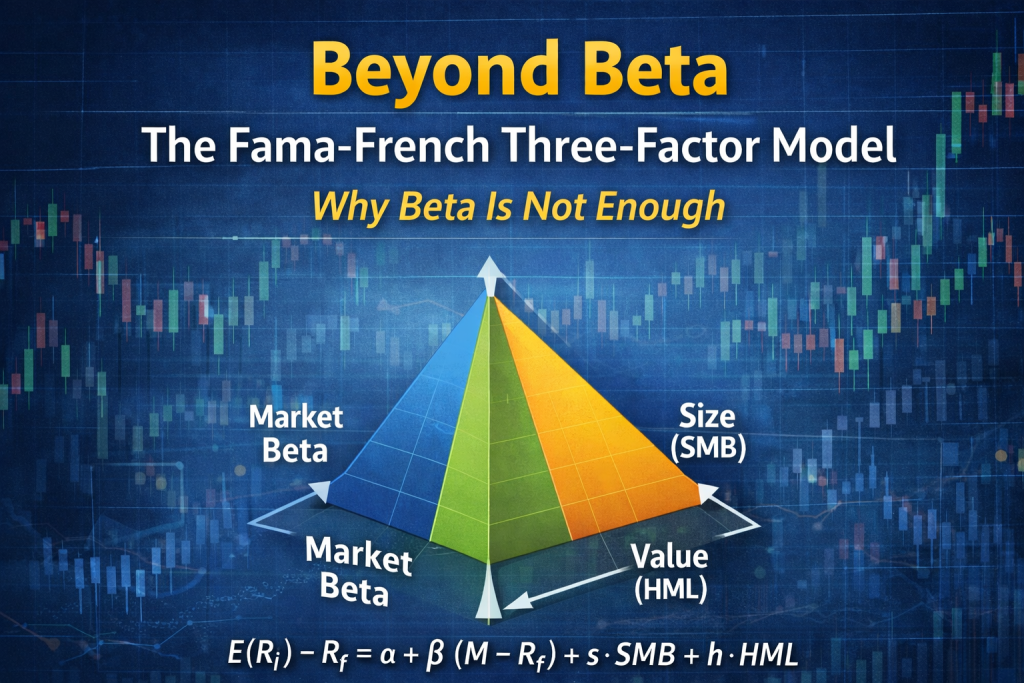
10.2 Only One Risk Factor
CAPM assumes market risk is the only relevant factor.
But research shows:
- Company size matters
- Value vs growth matters
- Momentum matters
This led to models like:
- Fama-French Three-Factor Model
- Arbitrage Pricing Theory (APT)
10.3 Unrealistic Assumptions
Markets are not perfectly efficient.
Investors are influenced by emotion.
Information is not equally available.
11. CAPM vs Modern Portfolio Theory
Modern Portfolio Theory focuses on:
- Portfolio construction
- Diversification
- Efficient frontier
CAPM focuses on:
- Pricing individual assets
- Determining expected return
- Linking risk to required return
MPT answers:
How should I build my portfolio?
CAPM answers:
What return should this asset provide?
Together, they form the backbone of modern finance.
12. Why CAPM Still Matters Today
Even after decades of criticism, CAPM remains:
- Taught in universities
- Used in corporate finance
- Applied in valuation models
- Used in investment banking
- Used in equity research
Why?
Because it provides a simple, logical benchmark.
Even advanced models often begin with CAPM.
Conclusion
The Capital Asset Pricing Model teaches one powerful truth:
The market only rewards systematic risk.
If you can diversify away a risk, you will not be paid for taking it.
Beta measures exposure to market risk.
The market risk premium measures the reward.
The risk-free rate anchors everything.
Together, they form one of the most important formulas in finance.



Pingback: The Fama-French Three-Factor Model: A Deeper Explanation Of Stock Market Returns — The Capital Process