
The Biggest Challenges Retail Traders Face in 2026 – And Why Most Never Overcome Them
In 2026, retail trading continues to attract millions worldwide, drawn by accessible platforms, real-time data, and the promise of financial independence. Yet the statistics remain stark: estimates consistently show that 70–90% of retail traders lose money over time, with many quitting within the first few years. Recent analyses from regulatory bodies and industry reports confirm this pattern persists, even as markets evolve with AI tools, increased volatility from geopolitical events, and shifting asset classes like precious metals.
Why does this failure rate barely budge? It’s rarely due to a lack of strategies or indicators. The core issues are deeper: emotional interference, inconsistent execution, and the absence of a repeatable, personalized process. Most traders treat trading like a hobby or gamble rather than a skill built through deliberate system development. This article explores the biggest challenges retail traders face in 2026, their psychological roots, why common “fixes” fall short, and how committing to building and refining one solid system offers the only realistic path to lasting improvement.
The Challenge in Detail: What Retail Traders Actually Struggle With in 2026
Retail traders today operate in an environment of unprecedented information flow and speed. Social media, AI-driven signals, 24/7 news, and low-commission brokers create constant stimulation. Yet this abundance often amplifies core problems rather than solving them.
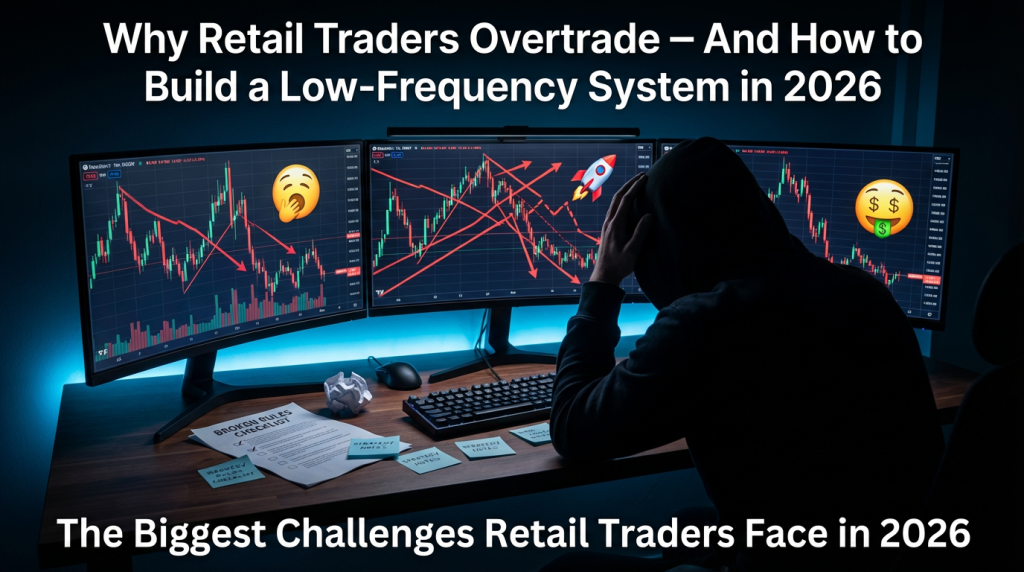
- Emotional Tilt and Revenge Trading: After a loss (or series of losses), frustration turns into impulsive entries to “get back” at the market. In volatile 2026 sessions—spikes from central bank announcements or commodity surges—this leads to oversized positions and blown accounts.
- Overtrading: Boredom, FOMO during trends (e.g., gold rallies past previous highs), or the urge to “make up” for quiet days result in excessive trades, higher costs, and diluted focus.
- Poor Risk Management: Risking too much per trade (often 5–10%+ of capital), moving stops emotionally, or having no max drawdown rules turns small losses into catastrophic ones.
- Inconsistency and Strategy Hopping: Jumping from one setup to another after a few bad trades, never allowing time for a system to prove its edge through sufficient samples.
- Information Overload and Unrealistic Expectations: Endless YouTube strategies, Discord signals, and “guru” promises create paralysis or blind following, ignoring personal fit (timezone, capital, tolerance).
- Lack of Journaling and Review: Without tracking trades in risk terms (R-multiples), expectancy, or emotional states, patterns remain invisible, and growth stalls.
These aren’t isolated issues—they compound. A single revenge trade can trigger overtrading, which erodes discipline and leads to abandoning a system prematurely. In 2026’s fast-moving markets, where gold and equities see sharp intraday moves, these behaviors are magnified.
Psychological & Behavioral Roots
Trading failures are behavioral first, technical second. Classic biases from behavioral finance drive most issues:
- Revenge trading stems from loss aversion—losses hurt twice as much as equivalent gains feel good—pushing traders to chase recovery.
- Overconfidence bias makes traders overestimate their edge after wins, leading to larger sizes or ignoring rules.
- Loss aversion causes holding losers too long or cutting winners early.
- Fear and greed fuel FOMO during trends or panic exits in drawdowns.
These aren’t character flaws—they’re human wiring. In high-stakes, uncertain environments like trading, the amygdala (emotional brain) often overrides the prefrontal cortex (rational planning). 2026’s volatility—driven by rate decisions, AI trading speed, and macro uncertainty—triggers these responses more frequently.
Why Most “Fixes” Fail
Traders try many solutions, but few last because they address symptoms, not the system gap:
| Common Fix | Why It Fails | Long-Term Result |
|---|---|---|
| New indicators / strategies | Shifts focus externally instead of building internal consistency | More hopping, same emotional patterns |
| Motivational videos / mindset quotes | Temporary dopamine hit; no structural change | Enthusiasm fades after next loss |
| Copying pro traders / signals | Ignores personal fit (risk tolerance, schedule) | Inconsistency when signals don’t align |
| Forcing “discipline” without rules | Willpower depletes; no fallback system | Back to old habits under stress |
These approaches feel productive but avoid the hard work: defining, testing, and living a single, evolving process.
Core Solution: Building / Upgrading the System
The antidote is commitment to one repeatable system tailored to you. A “system” here means a clear set of rules covering market selection, entry/exit criteria, risk parameters, and review process—not a fancy indicator combo.
Step 1: Define Your Foundation
- Assess yourself: Capital size, available time, risk tolerance (e.g., max 1–2% per trade), personality (patient vs. active).
- Choose timeframe/markets: Day trading forex/gold? Swing stocks? Match to life.
- Set non-negotiable goals: e.g., “Preserve capital first, aim for 1–2R average per month.”
Step 2: Build Core Rules
- Risk Rules First: Max risk 1% per trade, 3–5% portfolio heat, hard daily/weekly loss limits (e.g., stop after -3R day).
- Entry Filters: Require multi-timeframe alignment or specific conditions (e.g., pullback to support in trend).
- Exit Rules: Profit targets, trailing stops, time-based exits—no discretion.
- Anti-Tilt Safeguards: Cooling period after losses, max trades per day, pre-trade checklist.
Step 3: Test & Journal
Use free tools like TradingView replay for manual backtesting (50–100 historical setups). Track every trade in a spreadsheet: date, setup, R-risk, outcome, notes on emotion/state.
Step 4: Refine Gradually
Review weekly/monthly: Calculate expectancy (avg win × win% – avg loss × loss%). Tweak only one variable after 100+ trades. Small, evidence-based changes compound.
This process turns trading from emotional reaction to probabilistic business.
Practical Implementation
Daily routine example:
- Pre-market: Review plan, mark key levels.
- Trading: Use checklist; log immediately.
- Post-market: Journal review (what followed rules? Emotional notes?).
- Weekly: Metrics summary, one potential tweak.
Red flags: Breaking rules repeatedly, skipping journal, increasing size after wins without data.
Gold Example / Variation
Gold’s volatility in 2026 (frequent $100+ swings) amplifies tilt and overtrading. Apply the system: Define bias (e.g., above key moving average), wait for pullbacks, risk 1% max. See how gold as a crisis hedge behaves in uncertain times—rules prevent emotional exits during rallies or panic buys in dips. Compare to gold vs stocks comparisons for context on when to allocate.
Conclusion & Next Steps
The biggest challenge isn’t the market—it’s ourselves. Most retail traders in 2026 stay stuck because they avoid building a true process. Start small: Pick one challenge (e.g., tilt), apply the framework above, track for 30 days. Progress shows in fewer rule breaks and smaller drawdowns, not overnight riches.
Consistency compounds. Start today.
Frequently Asked Questions
How long does it take to build consistency with a system?
Realistic timeline: 6–18 months of deliberate practice (100–300+ tracked trades). Early signs appear in 2–3 months: fewer emotional breaks, better risk adherence, stabilizing drawdowns. Focus on process adherence over P&L initially.
What if my personality doesn’t suit strict rules?
Systems aren’t one-size-fits-all. Start with unbreakable risk limits and journaling, then add flexibility (e.g., discretionary elements within defined zones). Discipline builds from repeated small wins—adapt the system to you, not vice versa.
Do I need expensive software for this?
No. TradingView (free tier) for charting/backtesting, Google Sheets for journaling, and a calendar for reviews suffice. Avoid tool overload early—it delays real behavioral work.
Can this work for part-time traders?
Yes—choose swing or higher timeframes. The key is consistency within your available window, not trade frequency. Quality setups > quantity.
What if I keep breaking rules anyway?
That’s normal early on. Shrink position size dramatically (0.25–0.5%), enforce mandatory breaks after violations, and review why emotionally. Treat breaks as data—refine safeguards.
Is journaling really necessary?
Essential. Without it, you can’t quantify expectancy or spot patterns. Even simple notes (setup, outcome, emotion) reveal 80% of fixes needed.


Pingback: Overcome Retail Trader Challenges: Discipline, Risk, Funding – DayProp Funding