
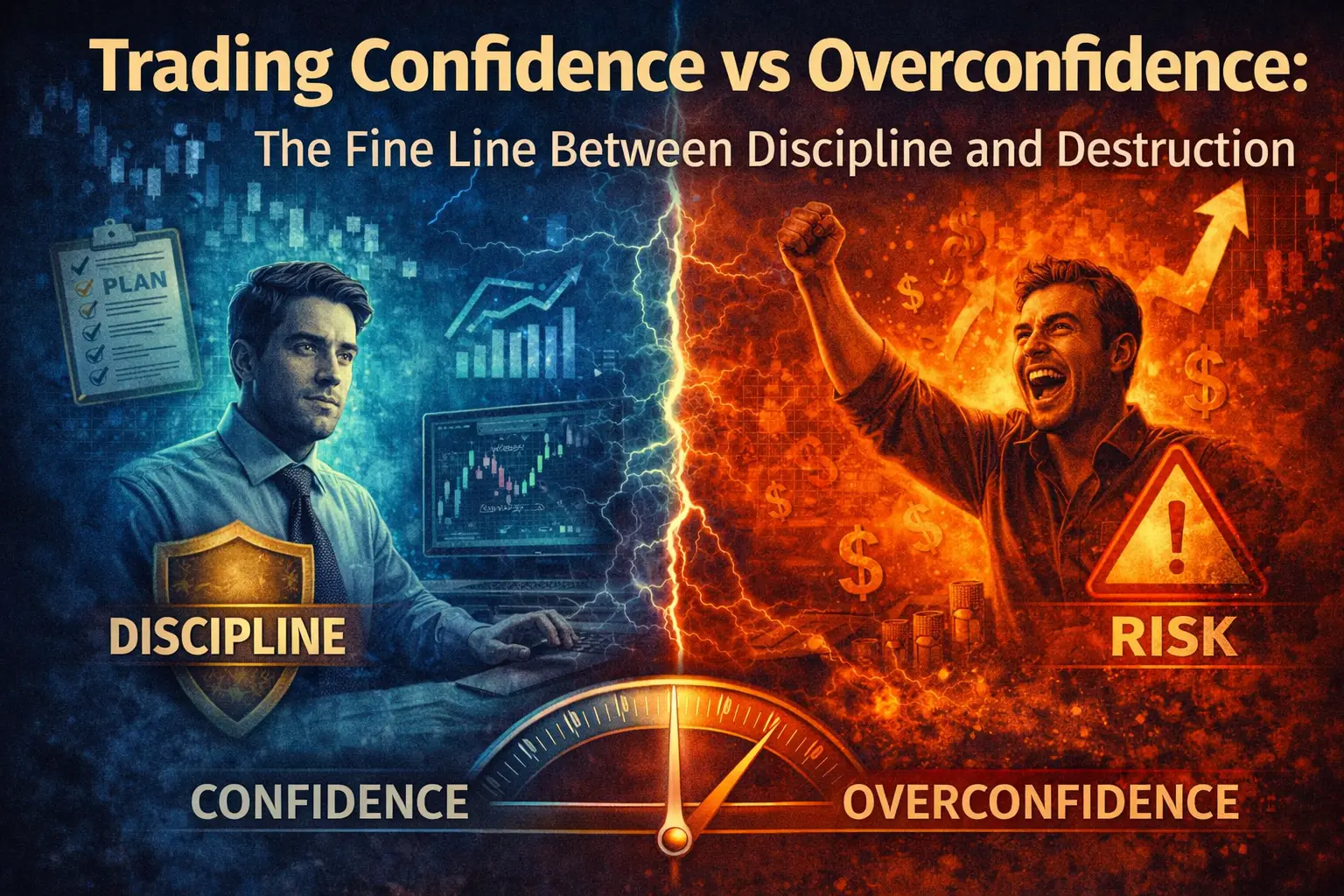
Trading Confidence vs Overconfidence: The Fine Line Between Discipline and Destruction
Confidence is essential in trading.
Without it, you hesitate.
You doubt your decisions.
You miss opportunities.
But too much confidence creates a different problem.
Overconfidence.
And overconfidence is one of the fastest ways to destroy a trading account.
This creates a dangerous balance.
You need confidence to execute.
But you must avoid overconfidence to survive.
Understanding this balance is critical for long-term success.
—What Trading Confidence Really Means
Confidence in trading is not about believing you will win.
It is about trusting your system.
It means:
- Following your rules consistently
- Executing trades without hesitation
- Accepting losses as part of the process
This aligns with execution discipline.
Because confidence is built on structure.
—What Overconfidence Looks Like
Overconfidence is different.
It is not based on structure.
It is based on emotion.
It often appears after:
- A series of winning trades
- Short-term success
- Luck mistaken for skill
And it leads to dangerous behavior.
—Signs of Overconfidence
Overconfidence is easy to recognize if you know what to look for.
—1. Increasing Position Size Without Justification
After a few wins, traders increase risk.
This creates instability.
—2. Ignoring Trading Rules
Traders start breaking their own system.
This is linked to breaking trading rules.
—3. Overtrading
Confidence leads to excessive trading.
This reduces selectivity.
—4. Believing You “Understand the Market”
Traders begin to think they can predict outcomes.
This is an illusion.
—The Cycle of Confidence and Overconfidence
Most traders go through a cycle:
- Start with low confidence
- Gain confidence through wins
- Become overconfident
- Experience large losses
- Lose confidence again
This cycle repeats.
And it prevents consistency.
—Why Overconfidence Is Dangerous
Overconfidence leads to:
- Increased risk exposure
- Poor decision-making
- Emotional trading
- Large drawdowns
Over time, this destroys capital.
—The Illusion of Skill
One of the biggest dangers in trading is confusing luck with skill.
Short-term success does not guarantee long-term profitability.
But traders often believe it does.
This leads to overconfidence.
—Real Trading Scenarios
To understand this concept, consider these examples.
—Scenario 1: Winning Streak
A trader wins 5 trades in a row.
They increase position size.
The next trade loses.
The loss wipes out previous gains.
—Scenario 2: Ignoring the System
A trader feels confident.
They take trades outside their system.
Losses occur.
—Scenario 3: Balanced Confidence
A disciplined trader follows their system.
They maintain consistent risk.
Over time, they remain profitable.
—The Turning Point
The moment a trader understands that confidence must be controlled is the moment they begin to mature.
Because they stop relying on emotion.
And start relying on structure.
How to Build Real Trading Confidence (Without Becoming Overconfident)
Confidence in trading is not something you assume.
It is something you earn.
And it must be built on structure, not emotion.
Below is a practical framework for developing real, stable confidence.
—1. Build Confidence Through Data
Confidence should come from evidence.
Not feelings.
This means:
- Backtesting your strategy
- Forward testing in live markets
- Tracking performance over time
This aligns with trading journaling.
Because data removes doubt.
—2. Focus on Execution, Not Outcomes
Confidence should be based on how well you follow your system.
Not whether the trade wins or loses.
This reduces emotional dependency.
This connects to execution discipline.
—3. Maintain Consistent Risk
Risk consistency stabilizes confidence.
Example:
- Always risk 1% per trade
This prevents emotional swings.
—4. Use a Structured Trading Plan
A clear plan reduces uncertainty.
And reduced uncertainty builds confidence.
This aligns with mechanical systems.
—How to Avoid Overconfidence Traps
Overconfidence does not appear suddenly.
It builds gradually.
You must actively control it.
—1. Treat Every Trade Independently
Previous wins do not affect future outcomes.
Each trade is a new probability.
—2. Do Not Increase Risk After Wins
This is one of the most dangerous behaviors.
Stick to your predefined risk.
—3. Follow Your System Strictly
Even after winning streaks, rules must be followed.
This prevents emotional trading.
—4. Stay Aware of Emotional Shifts
Recognize when confidence is turning into arrogance.
This is where discipline matters.
—The Confidence Stability Model
Stable confidence is achieved when three elements are aligned:
- System (strategy)
- Execution (discipline)
- Risk (control)
If any of these fail, confidence becomes unstable.
—The Role of Risk in Confidence
Risk directly affects psychology.
High risk increases emotional pressure.
Low, consistent risk stabilizes behavior.
This aligns with risk management.
—How Professionals Maintain Confidence
Professional traders do not rely on emotion.
They rely on structure.
—1. They Follow Their System
Consistency builds trust.
—2. They Control Risk
They avoid emotional exposure.
—3. They Focus on Long-Term Performance
They understand that individual trades do not matter.
—4. They Review Their Performance
They continuously improve.
—Common Mistakes Related to Confidence
Understanding mistakes helps prevent them.
- Overconfidence after wins
- Lack of confidence after losses
- Changing strategy frequently
- Increasing risk impulsively
These behaviors create inconsistency.
—The Long-Term Advantage of Balanced Confidence
When confidence is stable, traders achieve:
- Consistent execution
- Reduced emotional swings
- Improved decision-making
- Long-term profitability
This creates a sustainable edge.
—The Final Shift
The most important realization is this:
Confidence is not about believing you will win.
It is about trusting your process.
This changes how you trade.
—Conclusion
Confidence is essential for trading success.
But it must be controlled.
Overconfidence leads to poor decisions and large losses.
By building confidence through data, maintaining consistent risk, and following structured systems, traders can achieve stability.
Because in trading, success is not about feeling confident.
It is about being consistent.
And consistency comes from controlled confidence.
[…] This connects directly to overconfidence in trading. […]