
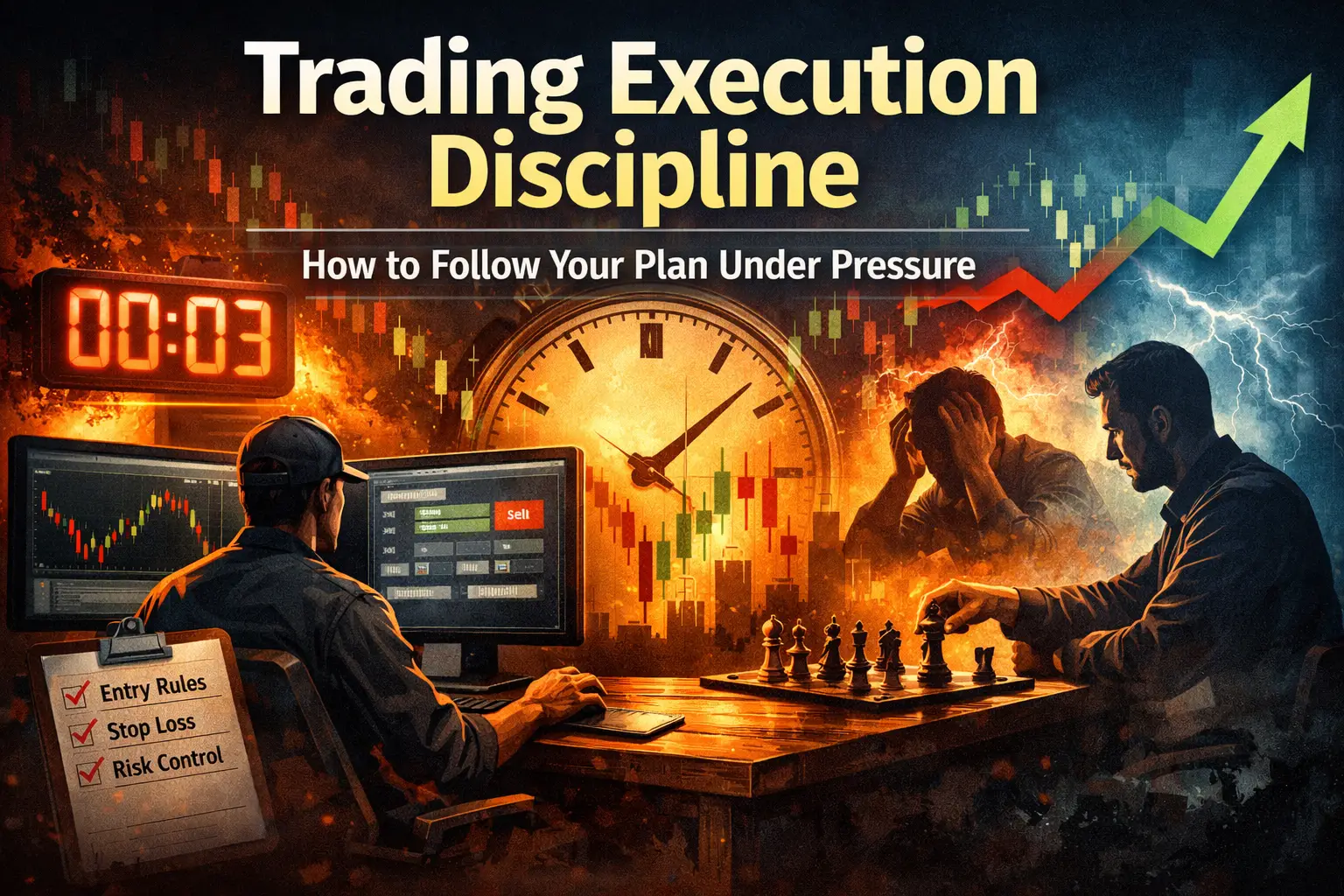
Trading Execution Discipline: How to Follow Your Plan Under Pressure
Most traders do not fail because of strategy.
They fail at the moment of execution.
This is where everything breaks down.
The analysis is done. The setup is clear. The plan is defined. And yet, when the moment arrives to act, something changes.
You hesitate.
You second-guess.
You override your own rules.
Or worse—you act impulsively.
This is the execution problem.
And it is one of the most misunderstood aspects of trading.
Because execution is not about knowledge.
It is about behavior under pressure.
—
The Moment Where Discipline Is Tested
Execution discipline is not tested during analysis.
It is tested in real time.
At the exact moment when:
- Price is approaching your entry level
- The market is moving quickly
- You are uncertain about the outcome
- Your capital is at risk
This is where emotions are triggered.
Fear, greed, and doubt become active.
And this is where most traders break their rules.
This behavior is closely related to what we explored in why traders break their own rules.
—
Why Execution Discipline Breaks Down
Execution failure is not random.
It follows specific patterns.
—
1. Fear of Loss
Even when a setup is valid, traders hesitate.
They fear being wrong.
This leads to missed opportunities.
—
2. Desire for Certainty
Traders want confirmation beyond their rules.
They wait too long.
The trade moves without them.
—
3. Emotional Reaction to Previous Trades
Recent outcomes influence current behavior.
After a loss → hesitation
After a win → overconfidence
This is linked to decision fatigue and emotional cycles.
—
4. Lack of Trust in the System
If you do not trust your strategy, you will not execute it consistently.
Doubt leads to hesitation.
—
5. Overexposure (Too Much Risk)
High risk increases emotional intensity.
When too much money is at stake, discipline breaks down.
This is why proper risk control is essential, as discussed in risk management strategies.
—
The Execution Gap
The execution gap is the difference between:
- What you know you should do
- What you actually do
This gap is where inconsistency is created.
It is the same concept behind the discipline gap.
And it is the primary reason why traders remain stuck.
—
What Execution Discipline Really Means
Execution discipline is not about being perfect.
It is about consistency.
It means:
- Taking every valid setup
- Avoiding invalid trades
- Respecting risk management rules
- Following your plan regardless of emotion
This is what separates professional traders from amateurs.
—
The Psychological Battle During Execution
When you are about to enter a trade, your mind creates conflict.
Two forces are at play:
Logic: Follow the system
Emotion: Avoid risk / chase opportunity
This internal conflict creates hesitation.
And hesitation leads to inconsistency.
—
Real-Time Execution Scenarios
To understand execution discipline, we must look at real scenarios.
—
Scenario 1: Hesitation on a Valid Setup
The setup is clear.
You know your rules.
But you hesitate.
The trade moves without you.
This creates frustration.
The next time, you may enter impulsively.
—
Scenario 2: Entering Too Early
You anticipate the setup.
You enter before confirmation.
The trade fails.
This is driven by impatience.
—
Scenario 3: Breaking Risk Rules
You increase position size after a win.
You feel confident.
The trade loses.
This creates instability.
—
Scenario 4: Moving Stop Loss
The trade moves against you.
You adjust stop loss to avoid being wrong.
The loss increases.
This is driven by loss aversion.
—
Why Knowledge Is Not Enough
Most traders already know what to do.
They know:
- They should follow their plan
- They should manage risk
- They should avoid emotional decisions
But they still fail.
Because knowledge does not control behavior.
Structure does.
—
The Turning Point
The breakthrough in trading comes when you realize:
“Execution is the real skill.”
Not analysis.
Not prediction.
Execution.
This is where consistency is built.
How to Build Execution Discipline (A Practical System)
Execution discipline is not built through motivation.
It is built through structure.
If you rely on willpower, you will fail under pressure.
If you rely on systems, you will maintain control.
Below is a practical system for building execution discipline.
—
1. Pre-Define Every Decision
The fewer decisions you make in real time, the more consistent your execution becomes.
This is why every aspect of your trading must be defined before the market opens.
This includes:
- Entry criteria
- Stop loss placement
- Take profit levels
- Risk per trade
When these are predefined, execution becomes mechanical.
This aligns with what we explored in mechanical trading systems.
—
2. Use a Mandatory Pre-Trade Checklist
A checklist acts as a gatekeeper.
No trade is taken without passing through it.
Example:
- Is this a valid setup?
- Is risk within limit?
- Does this align with my strategy?
- Am I emotionally stable?
If any condition fails, the trade is rejected.
This removes impulsive behavior.
—
3. Fix Your Risk (No Exceptions)
Variable risk creates emotional instability.
Fixed risk creates control.
Example:
- Risk 1% per trade
- Never increase risk based on emotion
This ensures consistency across trades.
—
4. Limit Trade Frequency
More trades create more opportunities to make mistakes.
Limiting trades improves focus.
Example:
- Maximum 2–3 trades per session
This forces selectivity.
—
5. Introduce Execution Rules
Your system must include rules specifically for execution behavior.
For example:
- No trade without confirmation
- No stop loss adjustment
- No revenge trading after losses
These rules directly target behavioral errors.
—
The Anti-Hesitation Framework
Hesitation is one of the biggest execution problems.
It occurs when:
- You doubt your system
- You fear losses
- You seek certainty
To eliminate hesitation, you must change your focus.
Instead of asking:
“Will this trade win?”
Ask:
“Does this trade meet my rules?”
This shifts focus from outcome to process.
And process reduces emotional conflict.
—
How to Build Trust in Your System
Execution discipline depends on trust.
If you do not trust your system, you will not follow it.
Trust is built through:
—
1. Backtesting
Testing your system on historical data builds confidence.
—
2. Forward Testing
Applying your system in live markets reinforces belief.
—
3. Tracking Results
Recording performance shows long-term consistency.
—
The Emotional Control Framework
Emotions cannot be removed.
They must be managed.
—
1. Reduce Position Size
Lower risk reduces emotional intensity.
This makes it easier to follow rules.
This aligns with trading small lots for discipline.
—
2. Accept Losses in Advance
Before entering a trade, accept the risk.
This reduces emotional resistance.
—
3. Avoid Overtrading
More trades increase emotional fatigue.
Fewer trades improve control.
—
The Execution Routine of Professional Traders
Professionals follow structured routines.
Before the Trade:
- Identify valid setups
- Define risk
- Prepare mentally
During the Trade:
- Execute without hesitation
- Follow rules strictly
- Avoid interference
After the Trade:
- Review execution
- Identify mistakes
- Improve process
This routine creates consistency.
—
The Long-Term Impact of Execution Discipline
Over time, execution discipline produces:
- Stable performance
- Reduced emotional stress
- Improved confidence
- Better risk control
This creates a compounding advantage.
Because consistency leads to growth.
—
The Final Shift
The biggest transformation in trading comes from one realization:
You do not need better analysis.
You need better execution.
This shift changes everything.
—
Conclusion
Trading success is not determined by what you know.
It is determined by what you do under pressure.
Execution discipline is the ability to act correctly in real time.
By building structured systems, reducing emotional influence, and focusing on process, traders can achieve consistent performance.
Because in the end, trading is not about finding the perfect setup.
It is about executing the same process repeatedly.
And that process is your edge.
[…] This is also closely tied to execution discipline. […]
[…] This aligns with execution discipline. […]
[…] This behavior is closely related to execution discipline. […]
[…] And it directly supports execution discipline. […]
[…] This is the same execution problem we explored in execution discipline. […]