Momentum investing is one of the most widely documented and profitable strategies in finance. Simply put:
Stocks that have performed well in the past tend to continue performing well in the near future.
Stocks that have performed poorly tend to continue underperforming.
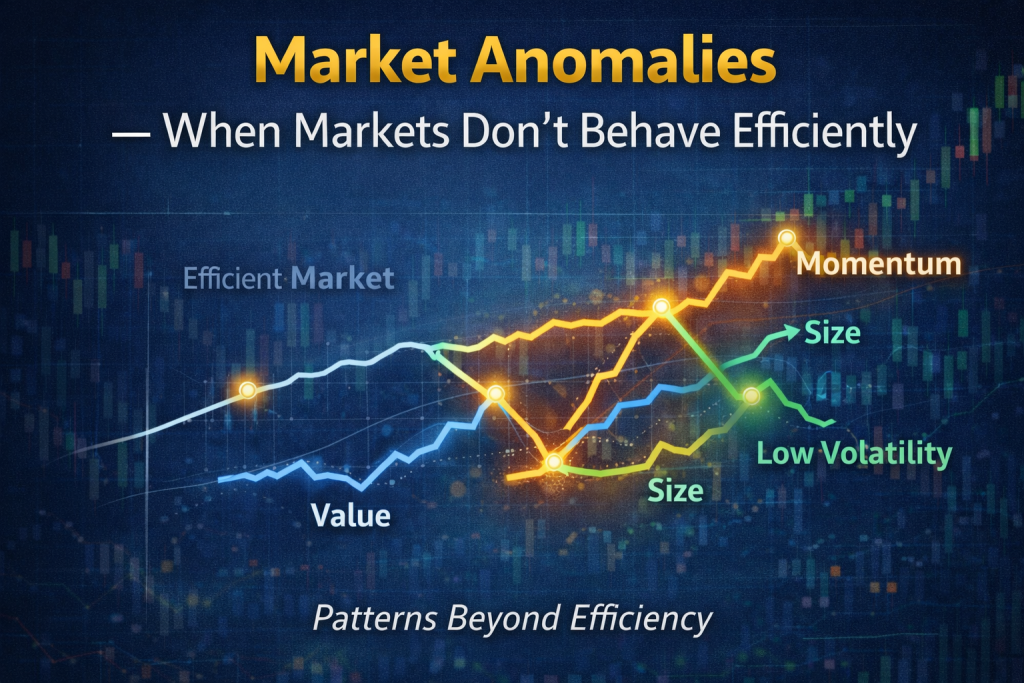
This idea challenges traditional finance. The Efficient Market Hypothesis (EMH) claims that past prices cannot predict future returns. Yet, decades of research show momentum works across:
- Stocks
- Bonds
- Commodities
- Currencies
In this article, we explore why momentum exists, the behavioral and risk-based explanations, and how investors can use it responsibly.
1. What Is Momentum Investing?
Momentum investing is the practice of buying “winners” and selling “losers” based on past performance.
Key characteristics:
- Uses historical returns to predict near-term performance
- Focuses on relative performance over 3–12 months
- Can be applied across sectors, markets, and asset classes
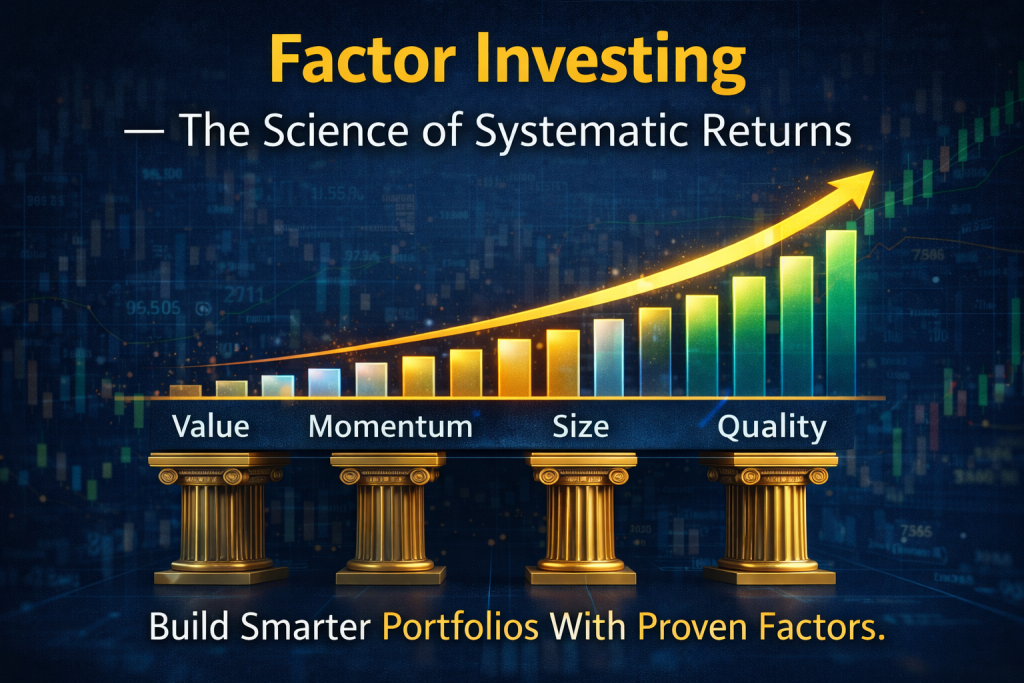
It is often used alongside other factors, like value or low volatility, to enhance long-term returns.
2. The Academic Discovery of Momentum
Momentum was first systematically documented in the early 1990s:
- Jegadeesh and Titman (1993) found that U.S. stocks with strong returns over the past 3–12 months continued to outperform over the next 3–12 months.
- Carhart (1997) incorporated momentum into a four-factor model (extending Fama-French) showing momentum explained returns beyond market, size, and value factors.
Momentum is now a cornerstone of factor-based investing.
3. Why Momentum Contradicts EMH
EMH predicts:
- Past price patterns should not predict future returns.
Momentum contradicts this:
- Past winners often continue winning
- Past losers continue losing
The persistence of momentum returns challenges weak-form efficiency.
This anomaly is one of the reasons factor investing exists today.
4. Behavioral Explanation: Underreaction & Herding
Behavioral finance provides a strong explanation for momentum:
- Underreaction: Investors are slow to respond to new information. A company with improving fundamentals may see gradual price increases instead of immediate adjustments.
- Herding: Once a stock gains attention, more investors pile in, driving prices higher.
Together, these psychological behaviors create the continuation of trends.
5. Risk-Based Explanation
Some researchers argue momentum may reflect hidden risk:
- Momentum strategies can crash during market reversals.
- Stocks that continue rising may be riskier in economic downturns.
- Momentum pays a premium for bearing specific risks not captured by CAPM or Fama-French factors.
Both behavioral and risk-based explanations likely contribute to momentum’s persistence.
6. Absolute vs Relative Momentum
- Absolute Momentum: Buy assets that have performed well in absolute terms (positive returns over a period).
- Relative Momentum: Buy assets that outperform their peers or benchmark over a period.
Relative momentum is more widely used in equity portfolios.
7. Cross-Sectional vs Time-Series Momentum
- Cross-Sectional Momentum: Compare stocks against each other to select winners and losers.
- Time-Series Momentum: Analyze each asset individually to determine if it’s in an upward or downward trend.
Both approaches can be combined for diversified momentum strategies.
8. Momentum Crashes
Momentum strategies have vulnerabilities:
- Large market reversals can lead to sharp, short-term losses.
- These crashes are often unexpected and correlated across sectors.
Risk management is crucial:
- Diversify across sectors and asset classes
- Use stop-losses or hedging
- Combine momentum with value or low-volatility factors
9. Combining Momentum with Value
Momentum and value factors often complement each other:
- Value identifies undervalued stocks.
- Momentum exploits ongoing trends.
Portfolios combining both factors historically outperform single-factor portfolios while smoothing drawdowns.
10. Practical Portfolio Implementation
- Define look-back period: Typically 3–12 months for equities.
- Rank assets: By past returns relative to peers.
- Select top performers: Usually top 10–30% for long positions.
- Select bottom performers: Usually bottom 10–30% for short positions (if allowed).
- Rebalance regularly: Monthly or quarterly.
- Diversify: Across sectors, countries, or asset classes.
Consistency and discipline are key. Emotional deviations can destroy momentum profits.
11. ETFs & Factor Funds
Many ETFs now provide momentum exposure:
- Momentum ETFs hold top-performing stocks based on historical returns.
- Multi-factor ETFs combine momentum with value, size, or low-volatility.
Investors can gain factor exposure passively, avoiding individual stock selection.
12. Risks and Drawdowns
Momentum is not without risk:
- Large short-term losses during market reversals
- High turnover leading to transaction costs
- Vulnerability during liquidity crises
Mitigation:
- Use diversification
- Manage position sizing
- Combine with defensive factors
13. Who Should Use Momentum?
Momentum is suitable for:
- Experienced investors who can tolerate volatility
- Factor-based portfolio managers
- Investors seeking alpha beyond CAPM or Fama-French strategies
Not recommended for:
- Short-term traders without risk management
- Investors seeking guaranteed returns
Discipline and risk control are critical.
14. Final Strategic Takeaways
Momentum investing demonstrates that:
- Past performance often predicts near-term returns
- Markets are not perfectly efficient
- Psychology and risk both drive anomalies
For investors:
- Use momentum in a disciplined, systematic way
- Combine with other factors like value or low volatility
- Focus on long-term trends and risk management
Momentum is a powerful tool — but only when applied intelligently.