Loss Aversion in Trading: Why the Fear of Losing Money Controls Trader Behavior
One of the most powerful psychological forces in financial markets is the fear of losing money. While every trader hopes to generate profits, the emotional impact of losses is often far stronger than the satisfaction gained from winning trades.
This phenomenon is known as loss aversion, a cognitive bias widely studied in behavioral finance. Loss aversion explains why traders frequently make irrational decisions when money is at risk.
Instead of objectively evaluating probabilities and market conditions, traders become focused on avoiding losses at all costs. Ironically, this desire to avoid losses often leads to decisions that increase them.
Understanding loss aversion is critical for traders who want to develop emotional discipline and long-term consistency.
Many of the destructive behaviors traders experience—such as holding losing positions, moving stop losses, or refusing to exit trades—are directly connected to this psychological bias.
This behavioral pattern is closely related to the psychological mistakes discussed in The Psychology of Holding Losing Trades, where emotional attachment to positions prevents rational decision-making.
In this article, we will explore how loss aversion affects traders, why it exists, and how disciplined traders build systems to prevent it from damaging their performance.
What Is Loss Aversion?
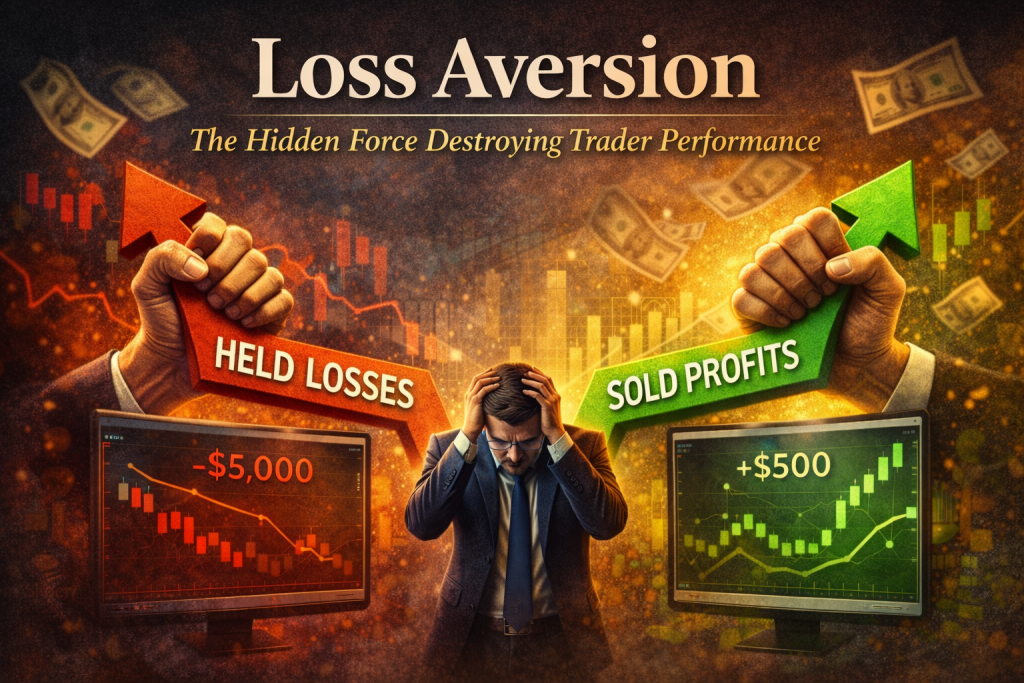
Loss aversion is a concept from behavioral economics which suggests that people experience the pain of losses more strongly than the pleasure of equivalent gains.
In simple terms, losing $100 feels worse than gaining $100 feels good.
This imbalance influences decision-making in many areas of life, but it becomes particularly powerful in trading because financial markets involve constant risk and uncertainty.
For traders, loss aversion often leads to emotional responses such as:
- Refusing to close losing trades
- Taking profits too quickly
- Avoiding valid trade setups after losses
- Moving stop-loss levels to avoid realizing losses
These behaviors create an imbalance in trading performance: losses become larger while profits become smaller.
The Psychological Origins of Loss Aversion
Loss aversion is rooted in human evolutionary psychology.
For most of human history, avoiding losses was essential for survival. Losing resources such as food, shelter, or safety could have life-threatening consequences.
As a result, the human brain evolved to prioritize loss avoidance.
However, financial markets require a different type of thinking. Traders must accept that losses are unavoidable and treat them as part of a probabilistic system.
When natural instincts conflict with market reality, psychological biases emerge.
How Loss Aversion Appears in Trading Behavior
Loss aversion manifests in several common trading mistakes.
Holding Losing Trades Too Long
Many traders struggle to close losing positions.
Closing a trade at a loss forces the trader to accept that the money is gone.
To avoid this emotional discomfort, traders may delay the decision and hope the market will reverse.
Unfortunately, markets often move further against the position.
This behavior is closely related to the psychological bias discussed in Why Traders Break Their Own Rules, where emotional pressure overrides disciplined execution.
Taking Profits Too Quickly
Loss aversion does not only affect losing trades. It also affects winning trades.
Because traders fear profits disappearing, they may close winning positions too early.
This creates a dangerous imbalance:
- Small profits
- Large losses
Over time, this imbalance makes consistent profitability extremely difficult.
Avoiding New Trades After Losses
After experiencing several losses, traders may become overly cautious.
They hesitate to enter valid setups because they fear experiencing another loss.
This hesitation can cause traders to miss high-quality opportunities.
The Mathematical Impact of Loss Aversion
Trading success depends on the relationship between average losses and average profits.
Loss aversion often creates the opposite of what traders need.
Consider two different trading behaviors:
Emotion-Driven Trading
- Average loss: $300
- Average profit: $100
Even if the trader wins many trades, large losses can eliminate profits.
Disciplined Trading
- Average loss: $100
- Average profit: $300
This structure allows traders to remain profitable even with moderate win rates.
The difference between these two scenarios is largely psychological.
Why Professional Traders Accept Losses
Professional traders view losses differently from most retail traders.
Instead of interpreting losses as personal failures, they treat them as operational costs.
Every trading strategy has a statistical edge that plays out over a series of trades.
Individual losses are simply part of that distribution.
This mindset is closely related to the probabilistic thinking discussed in Outcome Bias in Trading, where traders learn to evaluate decisions based on process rather than results.
How Professional Traders Control Loss Aversion
Successful traders do not rely on willpower alone to control psychological biases. Instead, they use structured systems that enforce discipline.
Predefined Risk Management
Professional traders determine their risk before entering a trade.
This typically includes:
- Stop-loss level
- Position size
- maximum percentage of capital at risk
Once the trade is active, these parameters remain unchanged.
Automated Stop-Loss Orders
Automating exits prevents emotional decision-making during stressful market conditions.
The platform enforces the risk limit automatically.
Thinking in Trade Series
Professional traders evaluate performance over large numbers of trades.
Instead of focusing on individual outcomes, they focus on long-term expectancy.
Practical Techniques to Reduce Loss Aversion
Developing emotional discipline requires deliberate practice and structured habits.
Reduce Position Size
Trading with smaller position sizes reduces emotional pressure.
When the financial impact of losses becomes manageable, traders find it easier to follow their rules.
Use a Trading Journal
A journal helps traders evaluate decisions objectively.
Recording trade reasoning, emotional state, and rule adherence helps identify patterns of behavior.
Focus on Process Over Outcome
Instead of asking whether a trade was profitable, traders should ask whether they followed their plan.
This shift in mindset helps reduce emotional reactions to losses.
The Long-Term Advantage of Accepting Losses
Ironically, traders who accept losses easily often perform far better than those who try to avoid them.
Accepting losses leads to:
- better risk management
- larger average profits
- greater emotional stability
- consistent execution
Losses are not the enemy of traders. Poor risk management and emotional decision-making are.
By understanding loss aversion and developing systems to control it, traders can transform one of their greatest psychological weaknesses into a source of strength.
Related Articles
- The Psychology of Holding Losing Trades
- Why Traders Break Their Own Rules
- Overcoming Emotional Tilt and Revenge Trading
- Outcome Bias in Trading
Frequently Asked Questions
What is loss aversion in trading?
Loss aversion in trading refers to the psychological tendency to fear losses more strongly than valuing equivalent gains.
Why do traders hold losing trades?
Many traders hold losing trades because closing them forces them to accept the loss, which creates emotional discomfort.
How does loss aversion affect profitability?
Loss aversion often causes traders to cut profits early while allowing losses to grow larger, creating an unfavorable risk-reward structure.
How can traders control loss aversion?
Using predefined risk management rules, automated stop losses, smaller position sizes, and trading journals can help reduce the influence of loss aversion.