For decades, traditional finance assumed something very simple:
Investors are rational.
Markets are efficient.
Prices reflect all available information.
This assumption shaped models like the Capital Asset Pricing Model (CAPM), Modern Portfolio Theory (MPT), and the Efficient Market Hypothesis (EMH).
But real-world markets tell a different story.
Investors panic during crashes.
Bubbles inflate far beyond fundamentals.
People hold losing stocks too long.
Traders become overconfident after small wins.
Entire markets move because of fear or excitement.
If investors are rational, why do these things keep happening?
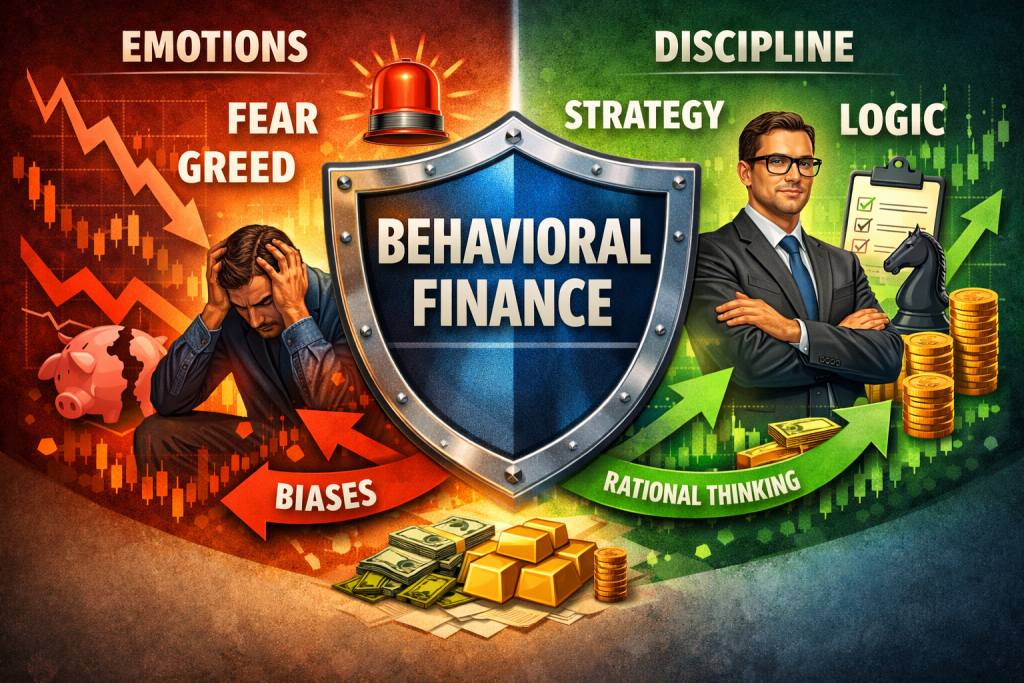
This is where Behavioral Finance comes in.
Behavioral finance blends psychology and economics to explain why investors systematically make irrational decisions — and how those decisions affect markets.
In this deep dive, you will learn:
- Why traditional finance assumes rationality
- Why humans are not rational decision-makers
- The core psychological biases that affect investing
- Prospect Theory and Loss Aversion
- Herd behavior and market bubbles
- Behavioral Finance vs Efficient Market Hypothesis
- How smart investors use behavioral awareness to gain an edge
Let’s begin.
The Myth of the Rational Investor
Traditional finance is built on a concept called “Homo Economicus” — the idea that individuals:
- Always act logically
- Maximize utility
- Evaluate risk objectively
- Use all available information efficiently
Models like the Efficient Market Hypothesis argue that since investors are rational, prices quickly reflect all known information.
But here’s the problem:
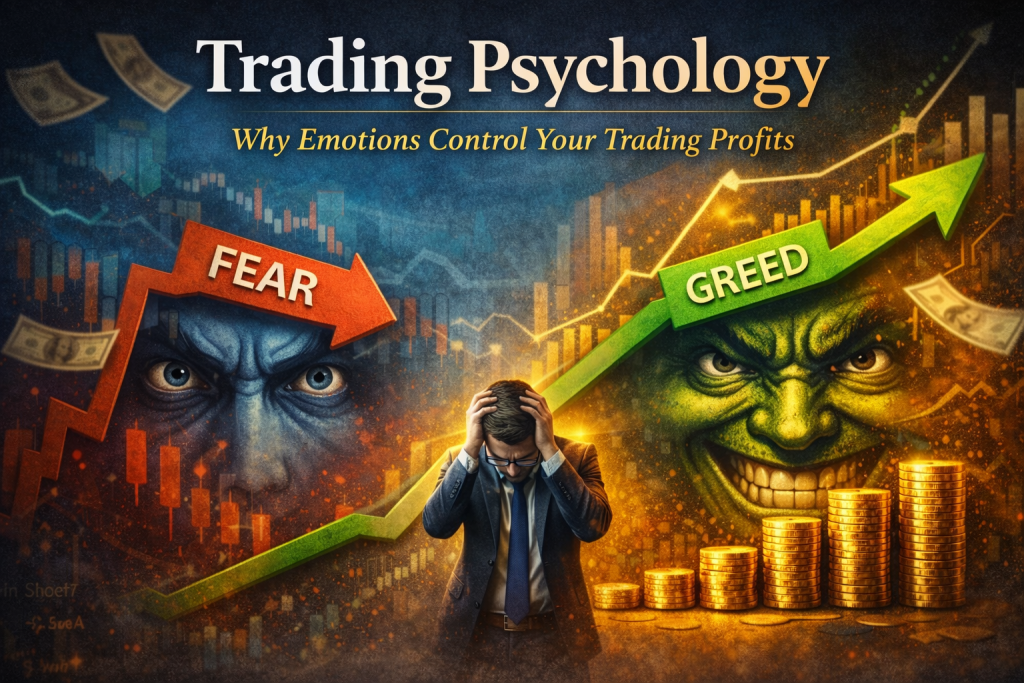
Humans are emotional.
We feel fear.
We feel greed.
We feel regret.
We feel overconfidence.
And emotions distort decisions.
If markets are driven by humans, markets cannot be perfectly rational.
Behavioral finance emerged to address this gap.
The Origins of Behavioral Finance
Behavioral finance gained serious academic recognition when psychologists began challenging classical economic assumptions about rational decision-making.
Research in cognitive psychology showed that humans rely on mental shortcuts (heuristics), are influenced by framing, and react emotionally to gains and losses.
One of the most important breakthroughs was Prospect Theory — a model explaining how people actually make decisions under risk.
This shifted finance from a purely mathematical discipline into one that integrates human psychology.
Prospect Theory: How We Actually Evaluate Risk
Prospect Theory explains several important behaviors:
- People fear losses more than they value equivalent gains.
- Decisions are made relative to a reference point (usually purchase price).
- People become risk-averse when facing gains.
- People become risk-seeking when facing losses.
Example:
If given a choice between:
- A guaranteed $500 gain
- A 50% chance to win $1,000
Most people choose the guaranteed $500.
But if given:
- A guaranteed $500 loss
- A 50% chance to lose $1,000
Most people choose the gamble.
This inconsistency violates classical rational theory — yet it is extremely common.
Investors do not treat gains and losses equally.
Loss Aversion: The Pain of Losing Is Stronger Than the Joy of Winning
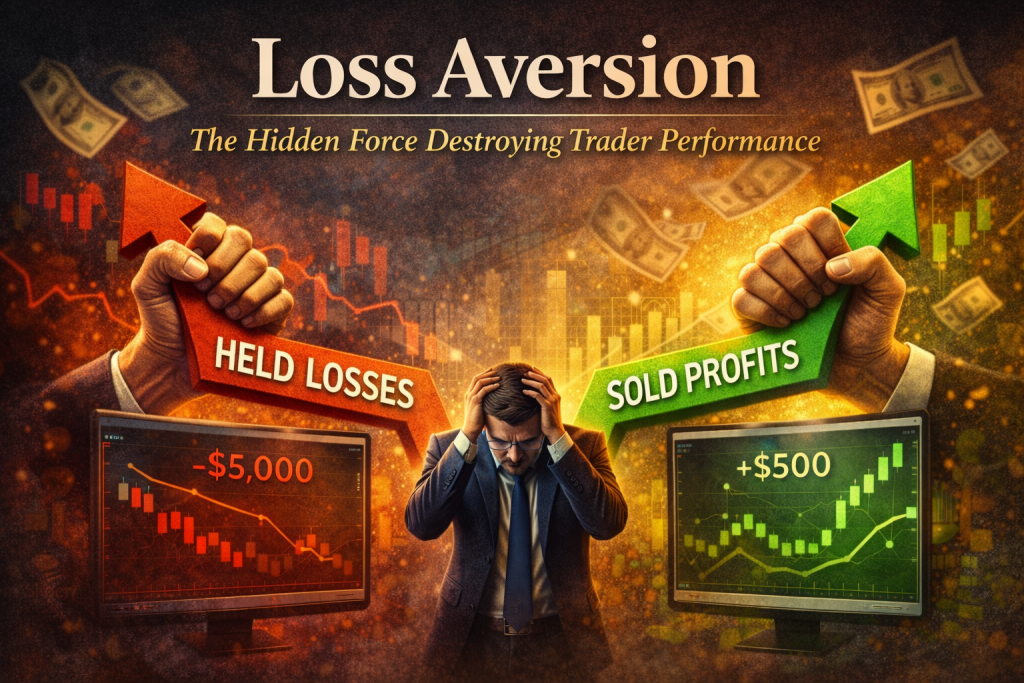
Loss aversion is one of the most powerful forces in investing.
Studies show the psychological pain of losing $100 feels roughly twice as strong as the pleasure of gaining $100.
This leads to:
- Holding losing stocks too long
- Refusing to sell at a loss
- Panic selling during downturns
- Avoiding necessary investment risks
Loss aversion explains why markets often overreact during crashes.
Fear dominates logic.
Overconfidence Bias
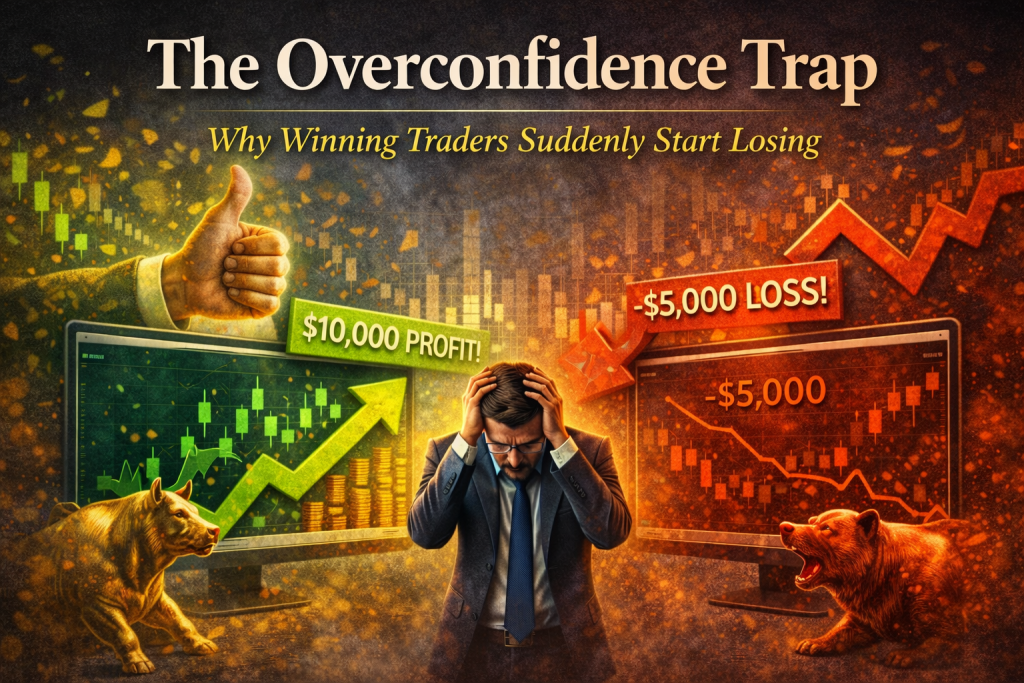
Overconfidence is the tendency to overestimate one’s knowledge, skill, or control over outcomes.
In investing, this leads to:
- Excessive trading
- Concentrated portfolios
- Ignoring risk
- Believing past success guarantees future performance
Many retail traders believe they can consistently beat the market — even when statistics show that frequent trading often reduces returns due to poor timing and transaction costs.
Overconfidence creates unnecessary risk.
Confirmation Bias
Confirmation bias occurs when investors seek information that confirms their existing beliefs and ignore contradictory evidence.
For example:
An investor believes a stock is undervalued.
They read only bullish reports.
They dismiss negative earnings warnings.
Instead of evaluating new data objectively, they filter information emotionally.
This traps investors in poor decisions.
Anchoring Bias
Anchoring happens when investors fixate on a specific number — usually their purchase price.
Example:
You buy a stock at $100.
It drops to $70.
Instead of asking, “Is this company worth buying at $70 today?”
You think, “I’ll sell when it gets back to $100.”
The original price becomes an emotional anchor.
But markets do not care about your entry point.
Rational decisions should be based on current information, not historical purchase prices.
Herd Behavior
Humans are social creatures.
When others buy, we assume they know something.
When others sell, we panic.
Herd behavior explains:
- Asset bubbles
- Meme stock surges
- Crypto manias
- Market crashes
Investors often feel safer moving with the crowd — even when the crowd is wrong.
But the crowd frequently buys near the top and sells near the bottom.
Mental Accounting
Mental accounting refers to the tendency to treat money differently depending on its source or category.
Examples:
- Taking more risk with “bonus money”
- Gambling with profits but protecting salary income
- Treating dividends differently from capital gains
In reality, money is fungible — but psychologically, we categorize it.
This leads to inconsistent investment decisions.
Market Bubbles and Crashes
Behavioral finance provides a powerful explanation for bubbles and crashes.
Bubbles often follow this psychological cycle:
- New opportunity or innovation
- Early success stories
- Media attention
- Public excitement
- Rapid price increases
- Speculative buying
- Extreme valuations
- Trigger event
- Panic
- Collapse
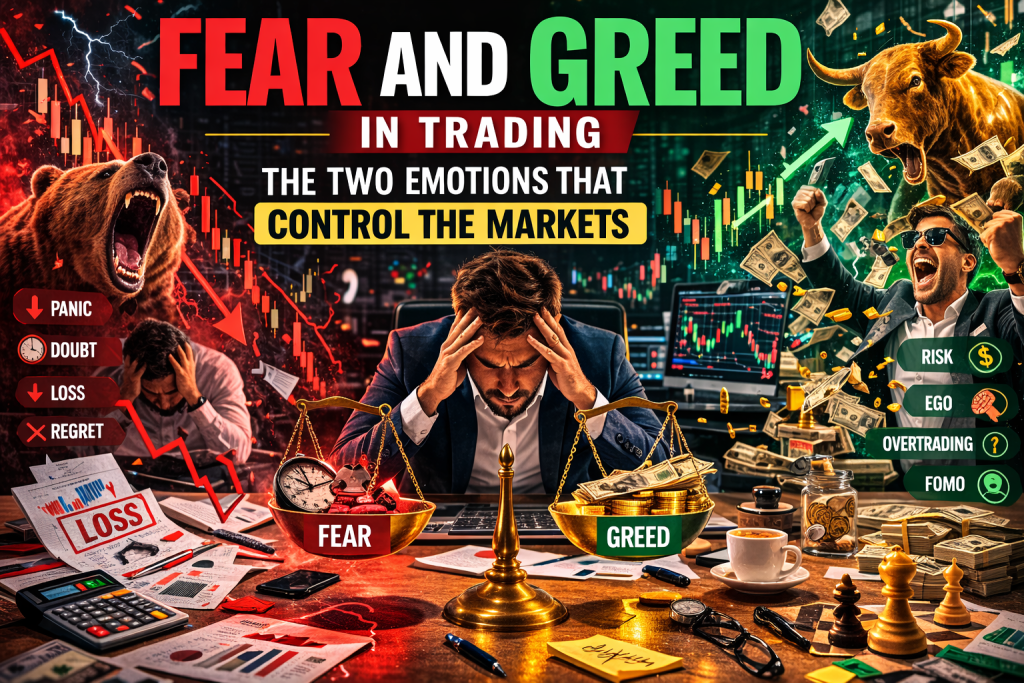
Fear and greed drive the cycle — not rational valuation.
Crashes are not just financial events. They are emotional events.
Behavioral Finance vs Efficient Market Hypothesis
The Efficient Market Hypothesis (EMH) states that prices reflect all available information.
Behavioral finance argues that prices reflect information AND psychological biases.
If markets were perfectly efficient:
- Bubbles would not persist.
- Overreactions would not occur.
- Momentum strategies would not work.
Yet real markets repeatedly show emotional extremes.
Behavioral finance does not entirely reject market efficiency.
Instead, it suggests markets are mostly efficient — but temporarily distorted by human behavior.
Can Behavioral Biases Create Investment Opportunities?
Yes.
When investors overreact to bad news, prices may fall below intrinsic value.
When investors follow the herd into speculative assets, prices may rise beyond fundamentals.
Disciplined investors can:
- Buy during panic
- Sell during euphoria
- Follow systematic strategies
- Avoid emotional timing
Behavioral awareness creates an edge — not by predicting emotions, but by controlling your own.
A Practical Behavioral Checklist for Investors
Before making any investment decision, ask:
- Am I reacting emotionally?
- Am I overconfident about my ability to predict outcomes?
- Am I ignoring contrary evidence?
- Am I anchored to my purchase price?
- Am I following the crowd?
- Would I make this decision if I had no position?
If you answer “yes” to any of these, pause.
Time reduces emotional distortion.
Strengths and Criticisms of Behavioral Finance
Strengths:
- Explains real-world investor behavior
- Explains bubbles and crashes
- Supported by psychological research
- Improves personal discipline
Criticisms:
- Hard to create precise predictive models
- Difficult to time irrational behavior
- Can be subjective
Despite limitations, behavioral finance permanently changed financial theory.
Final Thoughts
Behavioral finance teaches a powerful truth:
The biggest risk in investing is not the market.
It is your own psychology.
Markets are influenced by fear, greed, overconfidence, and social pressure.
Understanding these forces:
- Improves discipline
- Reduces emotional mistakes
- Strengthens long-term performance
- Creates opportunity during chaos
The best investors do not eliminate emotion.
They build systems that protect them from themselves.
And that is the true behavioral edge.