Factor Investing
For decades, investors believed that stock market returns were mostly driven by broad market exposure. The idea was simple: buy a diversified portfolio, hold it long enough, and the market will reward you.
However, financial researchers eventually discovered something surprising.
Certain characteristics of stocks consistently generated higher returns over long periods of time. These characteristics were not random. They appeared repeatedly across markets, decades, and economic conditions.
These persistent return drivers became known as investment factors.
Today, factor investing is one of the most influential frameworks used by institutional investors, hedge funds, pension funds, and quantitative investment firms. It sits at the intersection of academic research and real-world portfolio management.
Instead of simply buying the entire market, factor investing focuses on specific attributes that historically explain why some investments outperform others.
Understanding factor investing helps investors:
- Understand the real drivers of returns
- Build more efficient portfolios
- Avoid relying purely on luck or speculation
- Apply research-backed investment strategies
In this article, we will explore:
- What factor investing is
- How the concept evolved in finance
- The major investment factors identified by research
- Why factors generate returns
- How investors can apply factor investing in practice
By the end of this guide, you will understand one of the most powerful frameworks used in modern portfolio management.
What Is Factor Investing?
Factor investing is an investment strategy that targets specific drivers of return known as factors.
A factor is a characteristic of securities that has historically been associated with higher returns or reduced risk.
Instead of simply investing in the market as a whole, factor investing involves systematically tilting a portfolio toward securities that exhibit certain characteristics.
For example, investors may tilt toward:
- Stocks that appear undervalued
- Companies with strong price momentum
- Smaller companies
- High-quality businesses
Each of these characteristics represents a different factor.
Factor investing therefore focuses on answering a deeper question:
Why do some stocks outperform others?
Rather than relying on intuition or stock picking, factor investing uses data, research, and long-term evidence to identify patterns in returns.
The Origins of Factor Investing
The foundation of factor investing can be traced back to academic finance research.
Early financial theory focused on the Capital Asset Pricing Model (CAPM). CAPM suggested that a stock’s expected return depended primarily on its sensitivity to overall market movements.
However, researchers began noticing something unusual.
Certain types of stocks consistently produced higher returns than CAPM predicted.
Two examples stood out:
- Small companies often outperformed large companies.
- Undervalued stocks often outperformed expensive growth stocks.
These patterns could not be fully explained by traditional models.
This led researchers to develop multi-factor models that expanded the idea of what drives returns.
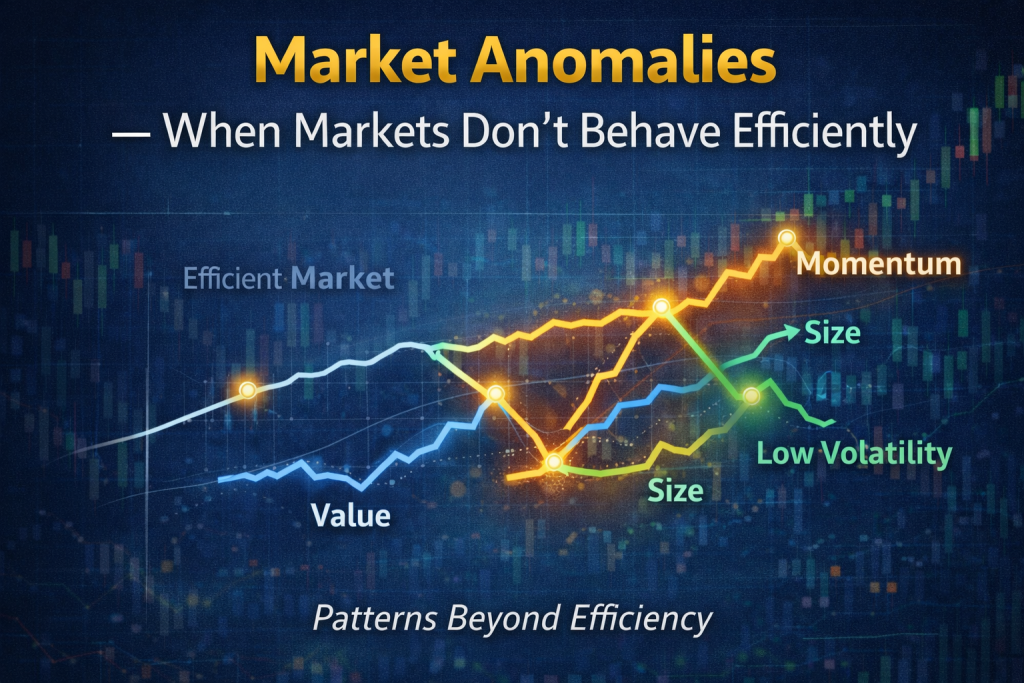
One of the most influential developments was the Fama-French Three Factor Model, which introduced additional factors beyond market risk.
Since then, the field of factor investing has expanded significantly.
Today, institutional investors analyze dozens of factors when constructing portfolios.
The Two Categories of Investment Factors
Investment factors are generally divided into two main groups:
- Macroeconomic factors
- Style factors
Each plays a different role in explaining investment returns.
Macroeconomic Factors
Macroeconomic factors reflect broad economic forces that influence asset prices.
These include:
- Economic growth
- Inflation
- Interest rates
- Currency movements
- Commodity prices
These factors affect entire markets rather than individual securities.
For example:
Rising interest rates may pressure stock valuations across the market.
Because macroeconomic factors influence large parts of the financial system, they are often analyzed by asset allocators and macro hedge funds.
Style Factors
Style factors are characteristics of individual securities that help explain differences in performance between investments.
These factors are the core of most factor investing strategies.
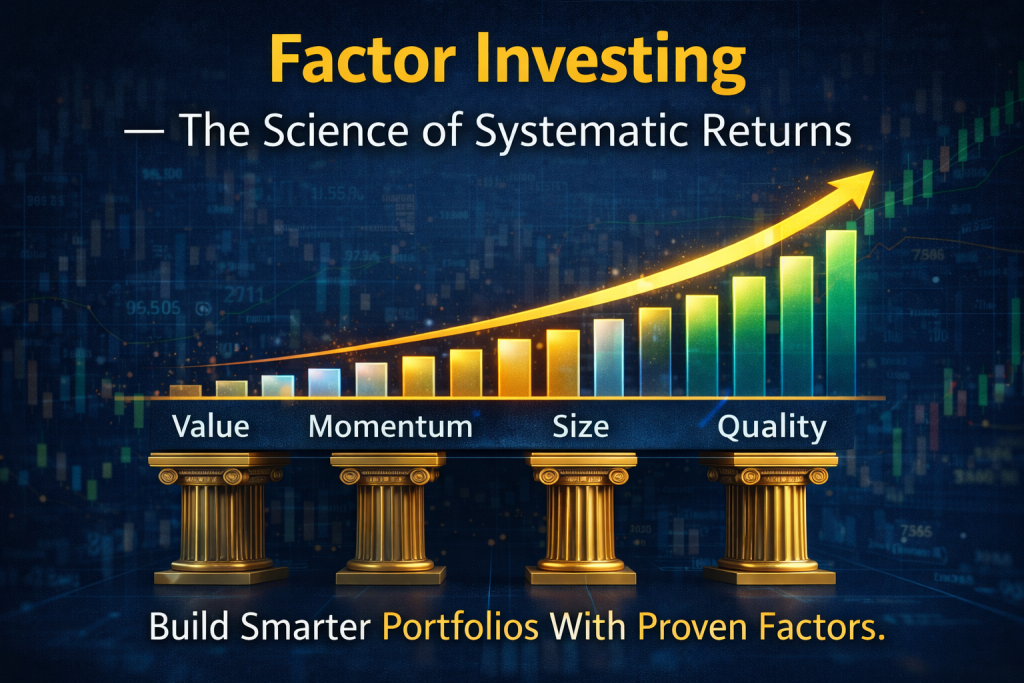
The most widely studied style factors include:
- Value
- Size
- Momentum
- Quality
- Low volatility
These factors have been studied extensively across multiple markets and time periods.
The Major Investment Factors
Let’s explore the most widely recognized factors used in modern investing.
Value Factor
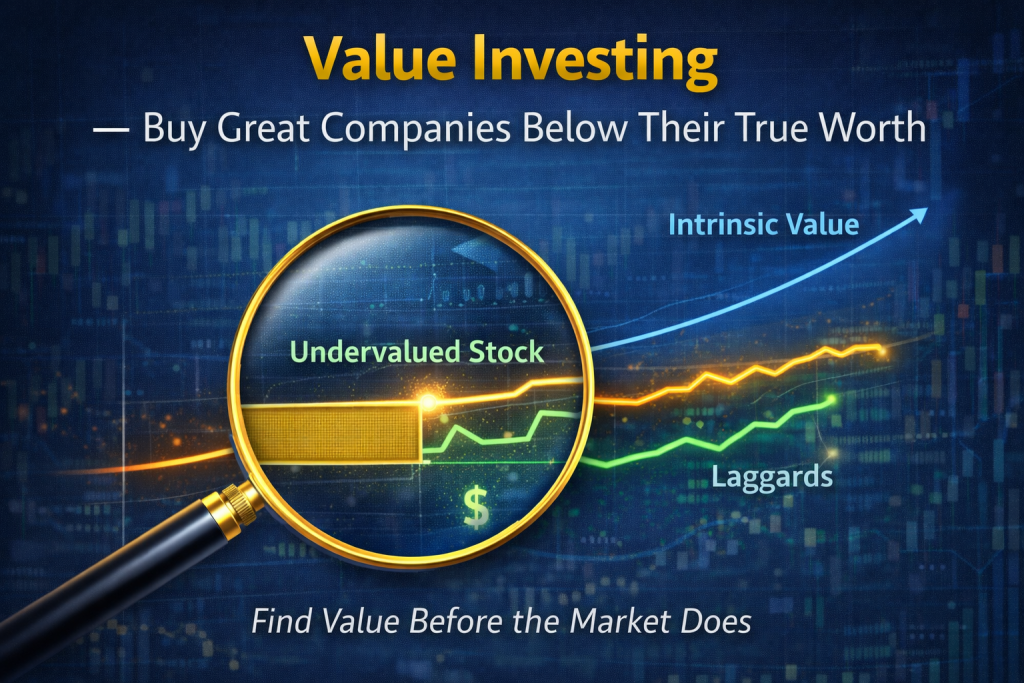
The value factor is based on the idea that undervalued stocks tend to outperform expensive ones over long periods.
Value stocks typically have:
- Low price-to-earnings ratios
- Low price-to-book ratios
- High dividend yields
These stocks are often unpopular or overlooked by the market.
Historically, value investing has produced strong long-term returns.
One explanation is behavioral.
Investors often overreact to bad news, pushing stock prices too low. When sentiment eventually improves, these stocks rebound.
Another explanation is risk.
Some value companies face genuine challenges, meaning investors demand higher returns as compensation for additional risk.
Size Factor
The size factor refers to the tendency of smaller companies to outperform larger companies over long periods.
Small-cap companies often:
- Have higher growth potential
- Operate in niche markets
- Are less widely researched by analysts
Because they receive less attention, small-cap stocks may occasionally become mispriced.
However, they also tend to be riskier than large companies.
Small businesses may face:
- Limited access to capital
- Greater business volatility
- Higher failure rates
As a result, investors may require higher expected returns to hold them.
Momentum Factor
The momentum factor captures the tendency for stocks that have performed well recently to continue performing well in the near future.
Similarly, poorly performing stocks often continue to underperform for a period.
Momentum is one of the most persistent anomalies in financial markets.
It has been observed across:
- Stocks
- Bonds
- Commodities
- Currencies
Momentum may exist due to behavioral biases.
Investors often react slowly to new information, causing trends to develop gradually rather than instantly.
Momentum strategies attempt to exploit this delayed reaction.
Quality Factor
The quality factor focuses on companies with strong financial fundamentals.
High-quality companies often exhibit:
- High profitability
- Stable earnings
- Strong balance sheets
- Efficient management
These companies tend to generate consistent returns while avoiding severe financial distress.
Investors often favor quality companies during periods of economic uncertainty.
Low Volatility Factor
Traditional finance suggests that higher risk should produce higher returns.
However, historical data has revealed an interesting anomaly.
Stocks with lower volatility have sometimes produced comparable or even superior returns compared to highly volatile stocks.
This phenomenon is known as the low volatility anomaly.
Several explanations have been proposed.
Some investors may prefer high-risk stocks because they resemble lottery tickets. As a result, these stocks may become overpriced.
Low volatility stocks, on the other hand, may be overlooked by investors seeking excitement or rapid gains.
Why Do Factors Work?
A key question in finance is why factors generate excess returns.
Researchers generally point to two main explanations.
Risk-Based Explanation
One explanation is that factors represent compensation for additional risk.
For example:
- Small companies may face higher failure risk
- Value companies may operate in struggling industries
Because these investments are riskier, investors demand higher expected returns.
Under this view, factor premiums are simply rewards for bearing certain risks.
Behavioral Explanation
Another explanation involves investor psychology.
Humans are not perfectly rational.
Behavioral biases can lead investors to:
- Overreact to bad news
- Chase recent winners
- Avoid unpopular investments
These biases can create mispricing in financial markets.
Factor strategies attempt to systematically exploit these behavioral patterns.
How Institutional Investors Use Factor Investing
Factor investing is widely used by institutional investors.
Large pension funds, sovereign wealth funds, and hedge funds often build portfolios that intentionally tilt toward specific factors.
For example:
A pension fund may allocate:
- 40% to market exposure
- 20% to value stocks
- 20% to momentum strategies
- 20% to quality companies
By combining multiple factors, investors aim to improve diversification and increase risk-adjusted returns.
This approach is sometimes called multi-factor investing.
Smart Beta: Bringing Factors to Index Investing
Factor investing has also influenced the development of smart beta strategies.
Traditional index funds weight companies by market capitalization.
This means the largest companies dominate the index.
Smart beta strategies take a different approach.
Instead of market capitalization, they construct portfolios based on factor characteristics.
For example:
- Value-weighted indices
- Low-volatility indices
- Dividend-focused portfolios
Smart beta strategies aim to combine the benefits of passive investing with factor-based tilts.
Risks of Factor Investing
Although factor investing has strong academic support, it is not without risks.
Factors can experience long periods of underperformance.
For example:
The value factor has historically gone through multi-year stretches of weak returns.
Investors who abandon strategies during these periods may fail to capture the long-term benefits.
Another challenge is factor crowding.
As factor investing becomes more popular, many investors may pursue the same strategies.
This can reduce the effectiveness of certain factors over time.
Building a Factor-Based Portfolio
Investors interested in factor investing can approach it in several ways.
Some choose to invest in factor-focused ETFs that target specific characteristics.
Others build diversified portfolios that combine multiple factors.
Key principles include:
- Diversifying across multiple factors
- Maintaining long-term discipline
- Avoiding excessive trading
- Keeping costs low
Factor investing works best as a long-term strategy rather than a short-term trading system.
The Future of Factor Investing
Factor investing continues to evolve as researchers analyze larger datasets and more sophisticated models.
New factors are regularly proposed, though not all withstand long-term scrutiny.
The most reliable factors tend to share several characteristics:
- Supported by strong academic research
- Observed across multiple markets
- Persistent over long periods
- Economically intuitive
As data science and quantitative investing advance, factor analysis will likely remain a core component of institutional portfolio management.
The Bottom Line
Factor investing represents one of the most important breakthroughs in modern finance.
Instead of viewing markets as purely random, factor investing identifies systematic patterns that help explain why some investments outperform others.
By focusing on characteristics such as value, momentum, size, quality, and volatility, investors can construct portfolios designed to capture these long-term return drivers.
However, factor investing requires patience and discipline.
Factors may underperform for extended periods, and no strategy works all the time.
For investors who understand these realities, factor investing offers a powerful framework for building diversified portfolios grounded in decades of financial research.